Feeds:
Posts
Comments

Archive for the ‘Lecture Notes’ Category

The Islands of San Francisco Bay

48 Islands*, 5 years, 3 different girlfriends, 220 pictures of 400 chosen from 600 rolls of film, tons of birds, 3 ghost towns, puns, jokes, and more than a few characters, our evening with James Marten was a fantastic trip around San Francisco Bay.

He quizzed the crowd on our birds and came away impressed with our knowledge, but he left us with some great images, and lots of new tidbits of fact and lore covering a fair swath of our Bay’s natural and unnatural history: an 11,000 year old horse tooth, 4,000 year old shell mounds, hideouts from the Spanish, sunken wooden ships, a wild west town, towns passed by the times, rock quarries, a world’s fair, an immigration station, a lighthouse, military bases, industrial salt manufacturing, utilities, private islands, to nature preserves and wildlife sanctuaries. All of these populated by a rich set of characters that have left their names in the landscape. Some of the stories James told came after his travels around the bay, he keeps learning new things as he travels around showing the photos, like the story of the man who waters a tree on the only remaining private island in the bay: Red Rock.

You can find a lot of this and 400 beautiful pictures in this book:  The Islands of San Francisco Bay.

* Two of the 48 islands are now flooded. And in case you were wonder — by island, James Marten refers to places officially recognized as islands.
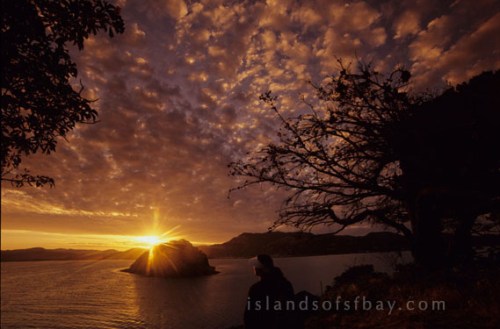
** The picture in this post is by James A. Marten, from Chapter 9 of his book The Islands of San Francisco Bay.

Read Full Post »

Saving the Frogs

Dr. Kriger knows his frogs. At the Randall, last lecture night, he imitated the ones he knows best: a series of Australian frogs, a brightly colored, alien eyed set of amhibians. His imitations of their little cries, as he introduced each one brought the crowd to laugher. But he had learned those sounds in earnest: he had to be able to imitate them so that he could find them, to get them to respond when he called.  They were otherwise invisible to him when he was doing his field research in Australia.

For all that frogs are hard to see and find, they are doing remarkably poorly for a group of animals that have lasted through 5 major extinctions. they are having a hard time surviving people. we humans have been setting aside many of the mountains as wildlife preserves, but of course we live in the lowlands, near water, the same place that frogs and other amphibians tend to live, and amphibians are getting the worst of it.

From habitat loss, the things we dump in the water, our desire for colorful frogs for pets, and frog legs for food, to the affects of invasive species, climate change and new infectious diseases we are loosing frog species at a rate far and above what has been lost before.

But as invisible as they can be, they may be more important to us than we think, as part of the food web, as a source for innovation in bioscience (about 10% of bioscience nobel prizes have involved frogs), as an eater of ticks and mosquitos. But also, less tangibly perhaps but most importantly, as fascinating and beautiful creatures that we share this planet with.

There is more information to be found at SAVE THE FROGS! Dr. Kriger founded this organization to bring the plight of these organisms to the attention of everyone. The organization has done a ton, but there is of course much more to be done. Join them at events round the world this April 29th, on Save the Frogs Day, 2011.

Pond First

Hopefully, it won't come to this!

Read Full Post »

Josiah Clark’s talk was an excellent wrap up to our year. Josiah’s work as an ecologist focuses on where the wild can fit into our urban centers. How we can take the highly fragmented green spaces of our cities and make them resilient and sustainable for the “last of the least and the best of the rest.”

The most fundamental aspect of that work is making these green spaces functional breeding areas. Keys to this is to have a lot of biodiversity (both of species and within species), and building up native plant communities, where communities is the operative word. Complex mashups of plants create all the more opportunities for all sorts of wildlife to thrive.

But each different area even within such a small city as San Francisco, can often need different management strategies. These strategies often hinge on understanding what the disturbance regimes (erosion, wind, floods, and nutrients) are like in a given area: for instance high tides at Crissy fields, fires (or the lack thereof) on San Bruno mountain, or wind blown dunes. Areas like dunes, serpentine and bluffs have poor nutrient soils, but because of their limits, often leaves native plants with better chances. Often times those disturbance regimes are the things that native plants were adapted to, and humans having built up or mitigated their affects has been to the detriment of native plants (like fire adapted coastal scrub). Our last remaining native rodent the gopher even provides positive disturbance, creating erosion where it otherwise would not happen.

Josiah then led us through a few case studies: the Green Hairstreak Project,  Nutall’s White Crowned Sparrow in the Bison paddock of Golden Gate Park, and the Pacific Chorus Frog. And how these were managed with all these things in mind.

And speakers have been bringing to us other examples of this all year long: Liam O’Brien talking on restoring the mission blue, Matthew Bettelheim and the western pond turtle, Brent Plater and Sharp park, John Bourgeois and salt pond restoration, our speakers on Yerba Buena island, Vance T. Vredenburg on frogs in the Sierras, and Camilla Fox showing us Coyotes in the city. We also had two historical overviews of the process of how our city came to its current fragmentation of habitats: one local — Joel Pomerantz and the Wiggle, once stream now bicycle route — and one area wide, Professor Richard Walker, giving us a history of bay area environmentalism.

We look forward to what we can bring out for you in 2011.

Read Full Post »

The Country and the City

Professor Walker, professor of Geology at UC Berkeley, gave us a quick introduction to the rich and complicated history of environmental leadership in the Bay Area. The bay area and its cities, he says, are a green quilt, a coat of many colors, a rich fabric of different types of landscape, all political spaces, constantly being fought over, but all-told preserving more open space than Yosemite does. Open space for which people STILL have to fight.

He walks through seven eras of the environmental movement in San Francisco: “the scenic wonders” and the creation of an ideology of preservation (with the likes of John Muir); “parks for the people,” where national parks are created, and the Redwood preservation league gets state parks going, where parks become popular recreation areas; “suburban revolt,” the first questioning of growth, as the Golden Gate Bridge is built from Marin, on into the freeways wars of San Francisco; “saving the bay,” how Save the Bay became the example for environmental membership organizations and brought the masses into the environmental fight; “greenbelt alliance,” the start of regional thinking and planning for the environment, and the unification of a lot of anti-growth groups; “land trusts,” started with the Trust for Public Land in Marin, preserving land in a new sort of way; and most recently, “brown environments,” environmental justice fights over toxic lands and brown fields.

One of the questions Professor Walker was interested in was what can we learn from all this time and effort. Here’s the highlights: upper class rebels have always been a part of the fight (tip your hats to the rich with a conscience); today the blocks of people who most vote for park bonds in order are: a) latinos, b) african-americans, c) asians, and last d) whites; women have been the backbone of local movements; the land has been put to use for the public, for the public good; the institutionalizing of organizations like Save the Bay keep the movement robust and keep a memory of what has already occurred.

All of this has lead to a political culture that is very deeply green, has saved us some amazing places, and still creating more.

You can read about all this more in depth in his book, the County and the City.

Read Full Post »

Salt Pond Restoration

John Bourgeois project manager for the South Bay Salt Pond Restoration Project led us through the history, present and future of the salt ponds that line the southern edges of the Bay, looking forward to a time where we might restore some good portion of the 90% of tidal wetlands that they Bay has lost. The Bay and its wetlands have long been affected by humans. Salt ponds actually were formed naturally on the eastern shore of the Bay, and then reinforced by Native Americans.

Sediment from gold mining brought the first mass human driven change to the Bay. Followed by the diking of hundreds of thousands of acres for agriculture 1860-1930. Landfill still threatens the bay in some parts. Salt Ponds were industrialized in the 20s with machine driven levee building.

The restoration process began in 1999 with local organizations developing a roadmap for restoring wetlands. The plans became a little more concrete in 2003 when 15,100 acres were purchased from Cargill.

But the actual plan is a 50 year plan, with a phased implementation attempting to grapple with the many uncertainties of restoration: how to support the wildlife that is using the salt ponds as they currently are (like snowy plovers, driven there perhaps by pressure on beach habitats), sediment dynamics (the ponds are always sinking and need to be at the right elevation to support plant life), mercury methylation, invasive species, how to drum up and sustain public support (what public access should be allowed), how to sustain the infrastructure for the project, and the rising waters driven by climate change.

The phase one of the restoration is aiming to answer these questions. One pond complex (near the Dumbarton Bridge) attempts to leave habitat for species currently using the ponds (but not typical tidal marshland dwellers), one pond complex (by the Guadalupe River) is attempting to understand the process of mercury methylation better, one pond complex (The Alviso complex) has shown that restoration of sediment can be swift, and that birds and fish numbers have jumped dramatically. Already they’ve learned a ton, and they can see ways to make things better (opening the water onto the existing tidal channels still exist unused within the salt ponds).

The whole process is a long list of minute details with affecting a whole host of organizations both public and private, all levels of government and of course local politics. Seemingly obvious good things (reusing sediment dredged from shipping channels) can be hampered by environmental regulation (and complex logistics).
The money for the restoration has to come from somewhere.

In some ways, it seems amazing that any of this has happened at all. But the signs seem positive! To find out more you can visit http://www.southbayrestoration.org/

Read Full Post »

The Plight of Amphibians

Over the course of my lifetime, I have heard many snippets about the plight of amphibians — which have always seemed to taken the brunt of human impacts in this modern world. On Thursday, Februart 18th, Vance Vredenburg gave us some more reasons to be concerned.

One is that until now, amphibians have been in general the survivors. Of the 5 great mass extinctions, they have weathered 4 of them. With humans, the driver of mass extinction of perhaps number six, amphibians are going extinct and being threatened by extinction at rates greater than mammals or birds. And in comparison to the other 5 great mass extinctions this one is unfolding in a very short time span under 10,000 years.

Vredenburg showed us examples of how Rana sierrae, the Sierra Nevada Yellow-legged Frog in particular is being affected. This species, one of 7 native to the Sierra Nevada, has declined by 92.5% since original studies were done by Grinell in the early 20th century. Grinell’s studies and the cataloging done of the Sierra Nevada’s has been great for science.

In what seems to me to be a bit of classic experimental science, Vredenberg and colleagues, went to test whether or not Rana Sierrae was affected by the fish that have been planted in the mountains. Fish panting started in the late 1800’s well before there was any noticeable decline in frog populations, so it had been discounted as a cause. But since the 50s and 60s, fish have been well stocked in the Sierra’s by air where they had never been (the upper Sierra lake’s being mostly inaccessible just by river). So, Vredenberg did a study by removing fish a number of ponds, and then comparing frog populations in control ponds where there were only fish or only frogs.

The results were dramatic, where fish were removed, the frog populations rebounded dramatically. But unfortunately for the frog the story did not end there. Over a number of years a disease has been sweeping through these and other frogs. Starting in 2004, the disease swept through the Sierras, and spread throughout the mountains in under 4 years denuding many lakes of frogs.

The disease is caused by an ancient aquatic fungus whose spores infect the skin of amphibians and create more spores. In that process the skin gets 4-40x thicker which disrupts the amphibian’s breathing and ultimately brings their demise through heart attacks.

Not all species are as affected. Some species are carriers, others are not affected, but the impact on the species it does affect is dramatic. It might be the worst known case of a pathogen affecting a vertebrate population. Diseases tend not to kill off their host species — something seems seriously out of whack.

Why should we care? There are all sorts of practical reasons: frogs have very similar hormones to us (so we ought to be paying attention), the principles of the disease and its spread are applicable to us (and presents a very sobering model), but most of all, we should care for the impractical reason that amphibians are beautiful creatures and we ought to pay attention to how we might be affecting them.

Read Full Post »

Last thursday night, Jan 28th, Camilla Fox showed us how coyotes are already out there living among us. In particular she told some amazing stories about the 2000 some coyotes who live in Chicago. What’s amazing isn’t the number that are there per se, but how little conflicts there actually are between them and us.

Since 1890, the Coyote has expanded into three times the amount territory and has come to be the keystone predator in a lot of ecologies. As that they provide ecosystem services — controlling other predators like feral carts, raccoons; controlling rodents and lagomorphs; and cleaning up carrion.

Contrary to myth, even in cities, domestic animals don’t make up a large portion of their diet, and a certain times of the year, fruits and berries become part of their diet. They are the ultimate flexitarian.

Camilla gave an intro to coyote biology ecology and noted how and where conflicts can occur: often as coyotes are protecting their young in their dens (as were two coyotes who were killed in golden gate park), and as unattached juvenile coyotes disperse in search of new groups to join. Camilla’s organization Project Coyote tries to educate the public and their governments how to better manage Coyote populations.

Coyotes often come into conflict with humans in cities when they have been accustomed to taking food from humans, and when they are sick (often with mange). Feeding coyotes is often a death knell for them. One strategy for us is to make sure the Coyotes are properly wary of people. Scare them off if you can.

The other reason paying attention to coyote biology is important is how control strategies can fail. Some scientists think that control efforts have led to an increase in population of smarter coyotes. Usually groups have a single breeding pair, but deaths of that pair can lead to a pack that is suddenly all having cubs.

Despite the war that humans have waged on coyotes possibly as many as 400,000 year are killed. Coyote populations remain strong (other interesting things are happening as well, like coyotes interbreeding with wolves and dogs). Removing coyotes can also lead to an increase in populations of raccoons and feral cats which have repercussions down the food chain.

Stable packs though maintain territory, keep out the young juveniles (or absorb them presumably) and have a more stable population.

Camilla left us with a video documenting the Coyotes arrival in San Francisco, and more information about how they cope in Chicago.

Learn more at http://www.projectcoyote.org/

Read Full Post »

SFSU Professor and California Academy of Science Board of Trustees President John Hafernik introduced us to the green roof of the Academy’s new building, and research into what has been finding its way up there.

His graduate students, lead by Jessica Van Den Berg, have been methodically catching and cataloging the insects that find there way into traps both on top of and near the museum for over a year. The roof was designed by Renzo Piano to lift up the park, but it is a good deal different from the surrounding flora.

Nine species of native California plants were originally planted on the roof. Native plants that were thought best adapted to surviving the somewhat harsh conditions of the roof, and the shallow soil. Those plants have been joined since by another 70 species or so (mostly planted near the observation deck).

The results of the study so far show that the roof’s insect population is much more diverse than that on the ground (dominated by two imports: the devil’s coach horse and pill bugs) . They have been pleased and surprised to see how quickly a rich web of species has been established: from herbivores (beetles and grasshoppers), pollinators like honey bees (and their mimics: drone flies) and bumble bees, predators like lacewings and wolf and jumping spiders, plenty of recyclers, i.e. flies, and perhaps most surprisingly a host of parasites and parasitoids.

Over 55 morphospecies (morphologically different species but still unidentified) of tiny and tinier wasps have been found (they make for beautiful pictures, but these are wasps species that are parasitoids: laying their eggs inside another insect species which then hatch and the eat their way out and eventually kill the host).

Other surprises have been native californian species like pigmy locusts, tricolor beetles not previously found in SF, but thought to be stowaways — carried here along with the plants from their original nursery. The surprising thing is that these species are still surviving the conditions (both generally live long creeks).

Also found was Agonum Muelleri, a European-Siberian beetle that has been slowly spreading around the world (and had as recent as 2008 been found in the Presidio).

What hasn’t been found so much is butterflies — unsurprising since not many host plants have been planted —  and ants. Native ant queens have been spotted  landing, but so far no colonies have been found. The argentinian ant has not yet found its way up, though it seems only a matter of time.

What next? Once cataloged and photographed, large and small, the insect samples will be turned in for genetic studies, fine tuning the knowledge of what is what on the roof.

As for the roof there is plenty more to study and to decide: how much to further encourage natives insects: nesting sites for bees, wood and other items for shelters, more host plants for butterflies and moths, and perhaps even importing some species that otherwise might not find their way up (ground dwelling species for instance).

Other studies might be done on other native gardens and how they compare. The academy, using citizen science will carry on the study of what is up there, to see how things will change over time. The studies will also be good information for future green roof projects.

More information on the roof and future projects can be found on the California Academy of Sciences green roof website.

Read Full Post »
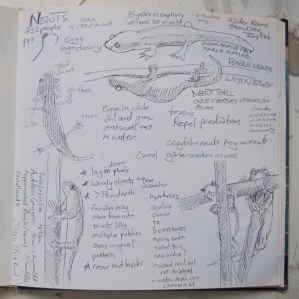
I Now Know Newts

my lecture notes for Karen Goetz's lecture

I now know at least a little bit about newts. Karen Goetz, with beautiful photographs,  introduced us to the natural history of the California Newt (Taricha torosa). Karen, as part of her graduate studies in Conservation biology, had studied how female newts selected their egg laying sites in the hills of the East Bay.

She lead with the life cycle of these amphibian’s (a type of salamander in fact): from their start as eggs the size of o large cherry, through their larval stage on into their adult life, their mating habits, and how they lay eggs, growing 6-8 inches, with toxins in their skin, and living for a surprisingly long time (20 years at least in the wild, with a record of 35 in captivity). Despite their toxic skin, they still have their predators, crayfish and garter snakes, and other newts as well.

What Karen had studied in particular was where the female salamanders lay their eggs. It turns out they tend to lay their eggs in deeper pools (greater than 37cm in depth), on woody objects of 9mm diameter or greater,  near muddy banks. Her hypothesis being that their choice relates a lot to biomechanics — how eggs fare in the seasonal flooding of California creeks: eggs fare best when laid on woody branches resilient to turbulent waters, and deep enough that they would avoid being hung out to dry before the eggs hatched.

Her pictures from under the water were ethereal glimpses of the lives of these animals. Probably the part we know best, as when they crawl out from the creek, there’s not a lot of data of how far, or doing what. We do know that newts, like many other amphibians, are vulnerable because they are so dependent on water for such a crucial part of their life. Humankind has had a huge impact in what it has been putting into the water, as well as how the water flows.

Read Full Post »

The Green Hairstreak Project

Liam O’Brien would like San Francisco to be remembered for more than the first known eradication of a butterfly species from the planet. The Xerces Blue went extinct in the 40s due to urbanization, and possibly because of the popularity of the butterfly in people’s butterfly collections in Victorian times. He would like to see the Green Hairstreak survive on the hills of San Francisco.

Liam took us through the biology and ecology of butterflies and why they can be so susceptible to human interference. Butterflies have host plants on which eggs will be laid, and some species including the Green Hairstreak is very particular (Deer weed and coastal buckwheat). Further, butterflies have a nectar source, and here again the Hairstreak is a picky eater of Wild Cucumber and Seaside daisy.

The butterflies only fly from 8-10 days in March through Mid May. The length of the season depending on the amount of spring rain. The larva sits in leaf litter for months before it pupates. The hairstreak is also one of 15 species in San Francisco that is a hill topper. Around 3pm in the afternoon the butterflies will fly to the top of one of the few hills they congregate looking for a mate. The females then disperse.

In an urban world this is the danger point for butterflies, especially the Green Hairstreak females looking for a spot to lay their eggs.

This where the Project comes in, trying to create corridors of habitat for these little minute creatures. Organizing people to grow and plant the host plants and nectar sources that will allow this “charismatic micro fauna” to survive. In this little project there is now a community of people who are coming together to plant a community of plants that will keep a community of animals.

Hopefully this can be a model for some of our other native species, and in the process bring us back a little of what we have lost. To find out more, check out their page on Nature in the City.

Read Full Post »

« Newer Posts - Older Posts »