Feeds:
Posts
Comments

Who Killed Off the Oysters of SF Bay?
Guest Speaker:  Andrew Cohen
7:30pm, Thursday, May 19th, 2011
Randall Musem, San Francisco, CA 

Marine Biologist, Andrew Cohen, will talk about our once-abundant native oysters, with excursions into history, biology, geology, and archaeology.

Andrew Cohen is the Director of the Center for Research on Aquatic Bioinvasions, and Adjunct Director of Biological Invasions Program at the San Francisco Estuary Institute.

Find out more about his work here, as well as these stories, on KQED (4/2011) and NPR (8/2006).

Christopher Richard, Curator of Aquatic Biology at Oakland Museum, gave us a great talk on April 21st on the mystery of Laguna Dolores.

Round about 1912 a map was published showing a lake next to the Mission Dolores. A version of this map was eventually enshrined in a monument on Albion near 16th street in the Mission. The author writing about this “now vanished” lake cited a historian who cited a historian who cited… well no one. But it has become a popular part of the myth of our city’s founding. An additional shine of luster as it were to our collective romanticism about our city before it was urbanized. A lake in the Mission!
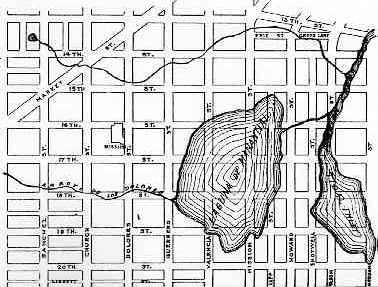
An erroneous map

But evidence — lots of evidence — shows that there never was a lake. Maps from the earliest days — in all their distorted glory (I can’t imagine being able to make a decent map as they did back then) — to the most recent pre-urbanized maps pretty much show the same thing in the area of the Mission: a tidal inlet coming in and curving south. Drawings of the area show a similar picture – one that did not include a lake. Richards walked us through map after map, and only a small sampling of the total volume he looked through.

What was there was certainly wet. There were also two creeks, a 14th street creek originating from a spring near Duboce Park, and a (perhaps) more seasonal creek on 18th. The 14th street creek was gradually diverted for irrigation and eventually paved over, though it still runs under the Armory and shows itself in particularly heavy rain. The spring is gone, as it was the result of water flowing through sand dunes now long covered over.

The 18th street creek went into a stand of willows which was for a time a popular place for outings. That stand connected into a body of water, not a lake, but a tidal inlet (depicted on the 1911 map as well). A drawing from the 1800s shows a creek like body of water, a bridge crossing where 16th is now, and the Mission in the distance. But no lake.

To understand where the idea of the lake came from, Christopher Richard went back to the source documents and maps, pouring over hundreds of them to get a sense of what happened. The Spanish it turned out oriented themselves to water features more than say mountains and hills and consequently had a richer language for water features. Nor were the text necessarily meant to be exacting descriptions of the surroundings. Subsequent translators weren’t careful to tease out the meanings, and perhaps the historians the map maker cited were confused by all this.

Father Palou did camp by a lake when he first came to San Francisco. It just wasn’t the Laguna Dolores, it was the tidal inlet. The term “springfed lake” which the 1911 map used for the mission lake, was the exact same term Captain Anza used to describe a different lake – Washerwomans Lagoon (located in the area where the  Marina is now — this lake is now vanished). And to top it off the shape on the lake on the 1911 map is suspiciously similar to the shape of Washerwoman’s cove on other maps.

The lake in the Mission then seems like it has vanished indeed. But never fear, there’s still plenty to be nostalgic for though: a tidal inlet, creeks, springs, and willows. I’d love to go and have paddle 🙂

Look for Christopher Richards work at the Oakland Museum of California.

Philip has been working hard scheduling for the fall. We’ve only one more month to fill out. Here’s the sketch outline so far:

July – Vanished Waters and the History of Mission Bay – Chris Carlsson
August – The Farallon Egg War – Eva Chrysanthe
September – San Francisco’s Changing Landscape – Greg Gaar
November – Reclaiming the Art of Natural History – John (Jack) Muir Laws

More details soon.

The Mystery of Laguna Dolores
Guest Speaker:  Christopher Richard
7:30pm, Thursday, April 21st, 2011

Christopher Richard, Curator of Aquatic Biology at Oakland Museum,  reexamines the “now vanished” lake at the heart of the founding myth of SF.

03 - Arroyo de Nuestra Senora del los Dolores (Lake of Our Lady of Sorrows) - 1

More Information:

FoundSF: Unravelling the Mystery of Lake Dolores

A walking map of SF

Ben Pease is a man after my own heart, rambling through all the corners of SF — hidden or not — on foot. He gave his talk on March 17, 2011.

He discovered the pleasures of urban explorations at an early age, and soon came to cartography, and in helping to produce maps for others, began working on his own project to map the walking paths of San Francisco.

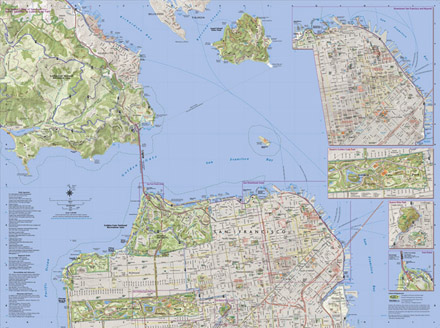
Taking inspiration from other mapmakers, both foreign and from the past (he showed one particularly beautiful map of San Francisco, made by Chevalier, faithful but wonderfully illustrated), and getting clarity on many a trail from older maps, he experimented to create a map of the right scale, and created a wonderful map of the city (and a little bit beyond through San Bruno mountain and part of the margin headlands).

He lead us in pictures through some of his favorite places: Lands End, the Embarcadero (viewing the bay from atop a pier), his own home patch in the Richmond District (with the smallest trail on the map), Candlestick Point, McClaren Park (with its springs and remnants of older owners), San Bruno Mountain (and a newly discovered path from the late 1800s), the Marin Headlands, Twin Peaks, and more.

If you have a favorite place, feel free to share it in the comments below. If not, check out The Walker’s Map of San Francisco, and look to find it!

Trails of San Francisco
Guest Speaker: Ben Pease
7:30pm, Thursday, March 17th, 2011

Ben Pease will discuss his new Walker’s Map of San Francisco, and share some of his favorite trails, parks, and neighborhoods in the City and beyond. How did they get there, anyhow?

A freelance cartographer since 1996, Pease has drawn maps for many Bay Area guidebooks, and has long been involved with the Bay Area Ridge Trail, Coastwalk, and Sutro Stewards.

Ben writes about maps, tools, and favorite San Francisco walks and places in his blog: Cartographer’s Notebook.

Recently, Ben served as one of the main cartographers for the new book Infinite City: a San Francisco Atlas by Rebecca Solnit and friends.


More information about the map’s can be found on the Pease Press website.

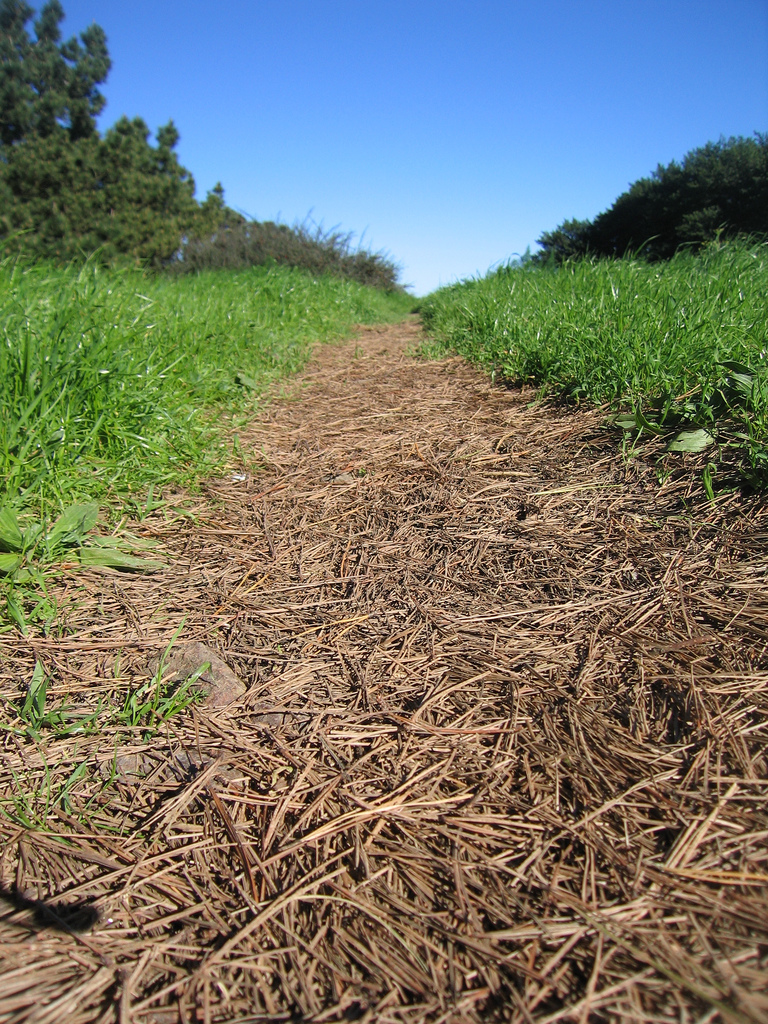
A Trail in San Francisco (Noe Valley)

The Islands of San Francisco Bay

48 Islands*, 5 years, 3 different girlfriends, 220 pictures of 400 chosen from 600 rolls of film, tons of birds, 3 ghost towns, puns, jokes, and more than a few characters, our evening with James Marten was a fantastic trip around San Francisco Bay.

He quizzed the crowd on our birds and came away impressed with our knowledge, but he left us with some great images, and lots of new tidbits of fact and lore covering a fair swath of our Bay’s natural and unnatural history: an 11,000 year old horse tooth, 4,000 year old shell mounds, hideouts from the Spanish, sunken wooden ships, a wild west town, towns passed by the times, rock quarries, a world’s fair, an immigration station, a lighthouse, military bases, industrial salt manufacturing, utilities, private islands, to nature preserves and wildlife sanctuaries. All of these populated by a rich set of characters that have left their names in the landscape. Some of the stories James told came after his travels around the bay, he keeps learning new things as he travels around showing the photos, like the story of the man who waters a tree on the only remaining private island in the bay: Red Rock.

You can find a lot of this and 400 beautiful pictures in this book:  The Islands of San Francisco Bay.

* Two of the 48 islands are now flooded. And in case you were wonder — by island, James Marten refers to places officially recognized as islands.
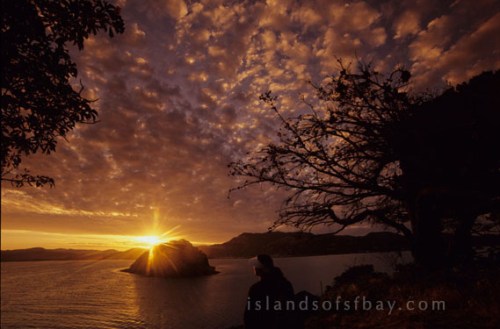
** The picture in this post is by James A. Marten, from Chapter 9 of his book The Islands of San Francisco Bay.

The Islands of San Francisco Bay
Guest Speaker: James Martin
7:30pm, Thursday, February 17th, 2011

James Martin discusses his book, the Islands of San Francisco Bay, documenting the the habitats of some 48 islands with their own unique ecologies and the histories.

The Marin Islands

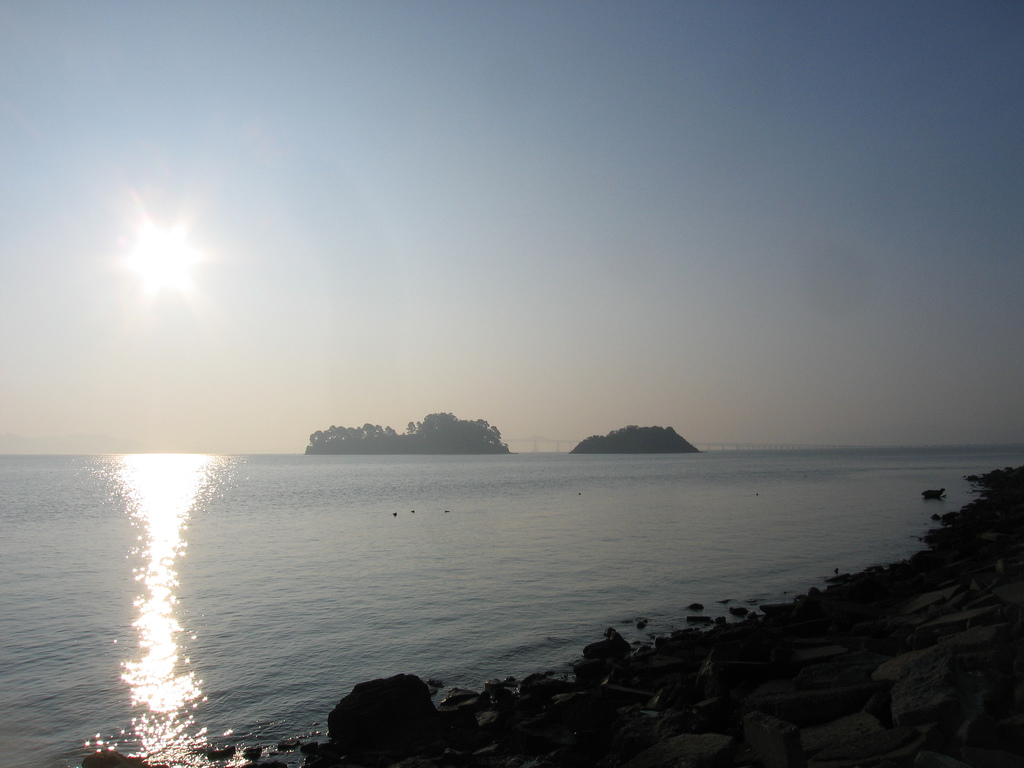
The Marin Islands (photo by Adrian Cotter)

“A newly published coffee-table-sized book of uncommon beauty is, in its conception, much more than a fabulous collection of dramatic nature scenery. With striking photographs by Marin County photojournalist and rock climber James Martin — who conceved and produced the book with the help of Petaluma native and fellow rock climber/photographer Michael Lee — their collaborative effort aims to capture the wildness of the island habitats in the hope of boosting environmental awareness of San Francisco Bay’s unique island ecology.”
“A Fascinating Look at the Islands Around Us”, by Sara Peyton, The Press Democrat

More information can be found on his website.

Saving the Frogs

Dr. Kriger knows his frogs. At the Randall, last lecture night, he imitated the ones he knows best: a series of Australian frogs, a brightly colored, alien eyed set of amhibians. His imitations of their little cries, as he introduced each one brought the crowd to laugher. But he had learned those sounds in earnest: he had to be able to imitate them so that he could find them, to get them to respond when he called.  They were otherwise invisible to him when he was doing his field research in Australia.

For all that frogs are hard to see and find, they are doing remarkably poorly for a group of animals that have lasted through 5 major extinctions. they are having a hard time surviving people. we humans have been setting aside many of the mountains as wildlife preserves, but of course we live in the lowlands, near water, the same place that frogs and other amphibians tend to live, and amphibians are getting the worst of it.

From habitat loss, the things we dump in the water, our desire for colorful frogs for pets, and frog legs for food, to the affects of invasive species, climate change and new infectious diseases we are loosing frog species at a rate far and above what has been lost before.

But as invisible as they can be, they may be more important to us than we think, as part of the food web, as a source for innovation in bioscience (about 10% of bioscience nobel prizes have involved frogs), as an eater of ticks and mosquitos. But also, less tangibly perhaps but most importantly, as fascinating and beautiful creatures that we share this planet with.

There is more information to be found at SAVE THE FROGS! Dr. Kriger founded this organization to bring the plight of these organisms to the attention of everyone. The organization has done a ton, but there is of course much more to be done. Join them at events round the world this April 29th, on Save the Frogs Day, 2011.

Pond First

Hopefully, it won't come to this!

The Wild World of Frogs
Guest Speaker: Dr. Kerry Kriger
7:30pm, THURSDAY, Jan 20th, 2011

yeah I'm on the brink of extinction, what are you going to do about it?

Dr. Kerry Kriger, Founder of SAVE THE FROGS, introduces us to frogs, why they are disappearing worldwide and what can be done to save them. Up to 200 species have disappeared since 1979, and nearly a 3rd of amphibian species are on the brink of extinction.

SAVE THE FROGS is America’s first and only charity dedicated to amphibian conservation. You can learn more at savethefrogs.org.