Feeds:
Posts
Comments

John Bourgeois project manager for the South Bay Salt Pond Restoration Project led us through the history, present and future of the salt ponds that line the southern edges of the Bay, looking forward to a time where we might restore some good portion of the 90% of tidal wetlands that they Bay has lost. The Bay and its wetlands have long been affected by humans. Salt ponds actually were formed naturally on the eastern shore of the Bay, and then reinforced by Native Americans.

Sediment from gold mining brought the first mass human driven change to the Bay. Followed by the diking of hundreds of thousands of acres for agriculture 1860-1930. Landfill still threatens the bay in some parts. Salt Ponds were industrialized in the 20s with machine driven levee building.

The restoration process began in 1999 with local organizations developing a roadmap for restoring wetlands. The plans became a little more concrete in 2003 when 15,100 acres were purchased from Cargill.

But the actual plan is a 50 year plan, with a phased implementation attempting to grapple with the many uncertainties of restoration: how to support the wildlife that is using the salt ponds as they currently are (like snowy plovers, driven there perhaps by pressure on beach habitats), sediment dynamics (the ponds are always sinking and need to be at the right elevation to support plant life), mercury methylation, invasive species, how to drum up and sustain public support (what public access should be allowed), how to sustain the infrastructure for the project, and the rising waters driven by climate change.

The phase one of the restoration is aiming to answer these questions. One pond complex (near the Dumbarton Bridge) attempts to leave habitat for species currently using the ponds (but not typical tidal marshland dwellers), one pond complex (by the Guadalupe River) is attempting to understand the process of mercury methylation better, one pond complex (The Alviso complex) has shown that restoration of sediment can be swift, and that birds and fish numbers have jumped dramatically. Already they’ve learned a ton, and they can see ways to make things better (opening the water onto the existing tidal channels still exist unused within the salt ponds).

The whole process is a long list of minute details with affecting a whole host of organizations both public and private, all levels of government and of course local politics. Seemingly obvious good things (reusing sediment dredged from shipping channels) can be hampered by environmental regulation (and complex logistics).
The money for the restoration has to come from somewhere.

In some ways, it seems amazing that any of this has happened at all. But the signs seem positive! To find out more you can visit http://www.southbayrestoration.org/
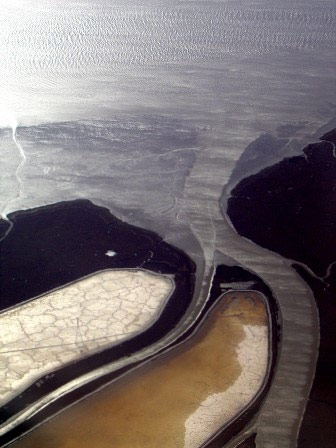
Restoring the Wild Heart of the South Bay – the South Bay Salt Pond Restoration Project
Guest Speakers: John Bourgeois
7:30pm, Thursday, May 20th, 2010

John Bourgeois, the Executive Project Manager for South Bay Salt Pond Restoration Project, will share with us their exciting restoration work. John Bourgeois has 15 years of experience working on large-scale wetland restoration projects. For 11 years he was a restoration ecologist with the Los Gatos-based ecological consulting firm H.T. Harvey and Associates.

You can learn more about the project here.

The Natural and Unnatural History of Yerba Buena Island and What Might Be Next
Guest Speakers: Peter Brastow, Liam O’Brien, Mike Lynes, Jake Sigg and Ruth Gravanis.
7:30pm, Thursday, April 22nd, 2010

A panel of experts will present an illustrated overview of YBI’s history, ecological treasures, threats and what the future might hold. Our fabulous panel of speakers will include:
Peter Brastow (Nature in the City founder),
Liam O’Brien (lepidopterist),
Mike Lynes (Golden Gate Audubon Society Conservation Director),
Jake Sigg (CA Native Plant Society) and
Ruth Gravanis.

Over the course of my lifetime, I have heard many snippets about the plight of amphibians — which have always seemed to taken the brunt of human impacts in this modern world. On Thursday, Februart 18th, Vance Vredenburg gave us some more reasons to be concerned.

One is that until now, amphibians have been in general the survivors. Of the 5 great mass extinctions, they have weathered 4 of them. With humans, the driver of mass extinction of perhaps number six, amphibians are going extinct and being threatened by extinction at rates greater than mammals or birds. And in comparison to the other 5 great mass extinctions this one is unfolding in a very short time span under 10,000 years.

Vredenburg showed us examples of how Rana sierrae, the Sierra Nevada Yellow-legged Frog in particular is being affected. This species, one of 7 native to the Sierra Nevada, has declined by 92.5% since original studies were done by Grinell in the early 20th century. Grinell’s studies and the cataloging done of the Sierra Nevada’s has been great for science.

In what seems to me to be a bit of classic experimental science, Vredenberg and colleagues, went to test whether or not Rana Sierrae was affected by the fish that have been planted in the mountains. Fish panting started in the late 1800’s well before there was any noticeable decline in frog populations, so it had been discounted as a cause. But since the 50s and 60s, fish have been well stocked in the Sierra’s by air where they had never been (the upper Sierra lake’s being mostly inaccessible just by river). So, Vredenberg did a study by removing fish a number of ponds, and then comparing frog populations in control ponds where there were only fish or only frogs.

The results were dramatic, where fish were removed, the frog populations rebounded dramatically. But unfortunately for the frog the story did not end there. Over a number of years a disease has been sweeping through these and other frogs. Starting in 2004, the disease swept through the Sierras, and spread throughout the mountains in under 4 years denuding many lakes of frogs.

The disease is caused by an ancient aquatic fungus whose spores infect the skin of amphibians and create more spores. In that process the skin gets 4-40x thicker which disrupts the amphibian’s breathing and ultimately brings their demise through heart attacks.

Not all species are as affected. Some species are carriers, others are not affected, but the impact on the species it does affect is dramatic. It might be the worst known case of a pathogen affecting a vertebrate population. Diseases tend not to kill off their host species — something seems seriously out of whack.

Why should we care? There are all sorts of practical reasons: frogs have very similar hormones to us (so we ought to be paying attention), the principles of the disease and its spread are applicable to us (and presents a very sobering model), but most of all, we should care for the impractical reason that amphibians are beautiful creatures and we ought to pay attention to how we might be affecting them.

Are We in the Midst of the Sixth Mass Extinction? A view from the world of amphibians
Guest Speaker: Vance Vrendenburg
Thursday February 18th, 7:30pm

sierran frog

Many scientists argue that we are either entering or in the midst of the sixth great mass extinction. Intense human pressure, both direct and indirect, is having profound effects on natural environments. SF State Professor, Vance Vrendenburg presents a view from the world of amphibians.

The amphibians—frogs, salamanders, and caecilians—may be the only major group currently at risk globally. A detailed worldwide assessment and subsequent updates show that one third or more of the 6,300 species are threatened with extinction.

This trend is likely to accelerate because most amphibians occur in the tropics and have small geographic ranges that make them susceptible to extinction. The increasing pressure from habitat destruction and climate change is likely to have major impacts on narrowly adapted and distributed species. Dalamanders on tropical mountains are particularly at risk.

A new and significant threat to amphibians is a virulent, emerging infectious disease, chytridiomycosis, which appears to be globally distributed, and its effects may be exacerbated by global warming. This disease, which is caused by a fungal pathogen and implicated in serious declines and extinctions of >200 species of amphibians, poses the greatest threat to biodiversity of any known disease.

Our data for frogs in the Sierra Nevada of California show that the fungus is having a devastating impact on native species, already weakened by the effects of pollution and introduced predators.

Vance Vrendenburg, SF State Professor, presents a general message from amphibians is that we may have little time to stave off a potential mass extinction. Learn more about his work at his website: http://web.me.com/vancevredenburg/Vances_site/Home.html

Last thursday night, Jan 28th, Camilla Fox showed us how coyotes are already out there living among us. In particular she told some amazing stories about the 2000 some coyotes who live in Chicago. What’s amazing isn’t the number that are there per se, but how little conflicts there actually are between them and us.

Since 1890, the Coyote has expanded into three times the amount territory and has come to be the keystone predator in a lot of ecologies. As that they provide ecosystem services — controlling other predators like feral carts, raccoons; controlling rodents and lagomorphs; and cleaning up carrion.

Contrary to myth, even in cities, domestic animals don’t make up a large portion of their diet, and a certain times of the year, fruits and berries become part of their diet. They are the ultimate flexitarian.

Camilla gave an intro to coyote biology ecology and noted how and where conflicts can occur: often as coyotes are protecting their young in their dens (as were two coyotes who were killed in golden gate park), and as unattached juvenile coyotes disperse in search of new groups to join. Camilla’s organization Project Coyote tries to educate the public and their governments how to better manage Coyote populations.

Coyotes often come into conflict with humans in cities when they have been accustomed to taking food from humans, and when they are sick (often with mange). Feeding coyotes is often a death knell for them. One strategy for us is to make sure the Coyotes are properly wary of people. Scare them off if you can.

The other reason paying attention to coyote biology is important is how control strategies can fail. Some scientists think that control efforts have led to an increase in population of smarter coyotes. Usually groups have a single breeding pair, but deaths of that pair can lead to a pack that is suddenly all having cubs.

Despite the war that humans have waged on coyotes possibly as many as 400,000 year are killed. Coyote populations remain strong (other interesting things are happening as well, like coyotes interbreeding with wolves and dogs). Removing coyotes can also lead to an increase in populations of raccoons and feral cats which have repercussions down the food chain.

Stable packs though maintain territory, keep out the young juveniles (or absorb them presumably) and have a more stable population.

Camilla left us with a video documenting the Coyotes arrival in San Francisco, and more information about how they cope in Chicago.

Learn more at http://www.projectcoyote.org/

Coyotes in Our Midst ~ Learning  to Live with America’s Wild “Song Dog
Guest speaker Camilla Fox
7:30pm, Thursday January 28th, 2010

Founding director of  Project  Coyote,  Camilla Fox, covers  coyote ecology and biology,  coyote-human coexistence,  conflict management,  and the  value of community-based conservation approaches.

Camilla H. Fox is the Founding Director of Project Coyote, a national non-profit organization that promotes educated coexistence between people and coyotes and advocates on behalf of all native carnivores. Her presentation will cover coyote ecology and biology in urban and rural ecosystems, coyote-human coexistence, coyote conflict management and the value of community-based conservation approaches.

Ms. Fox will also show Project Coyote’s (in partnership with Living World Films) new documentary American Coyote ~ Still Wild at Heart.

Looking forward to our 2010 schedule so far, and to our first lecture next week.

January 28, 2010:
Coyotes in Our Midst ~ Learning  to Live with America’s Wild “Song Dog”  Founding director of  Project  Coyote,  Camilla Fox, covers  coyote ecology and biology,  coyote-human coexistence,  conflict management,  and the  value of community-based conservation approaches.

February 18, 2010:
Are We in the Midst of the Sixth Mass Extinction? – A view from the world of amphibians  – Vance Vrendenburg, SF State Professor, will tell us about his research into the infectious disease that has globally been killing  amphibians  and possible ways  to save  them from extinction

March 26: Cancelled

April 22:
Yerba Buena Island – Ruth Gravanis

May 27:
Salt Pond Restoration – Mendel Stewart

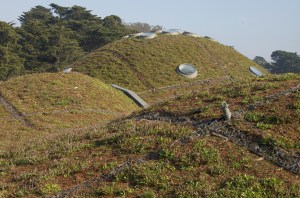
SFSU Professor and California Academy of Science Board of Trustees President John Hafernik introduced us to the green roof of the Academy’s new building, and research into what has been finding its way up there.

His graduate students, lead by Jessica Van Den Berg, have been methodically catching and cataloging the insects that find there way into traps both on top of and near the museum for over a year. The roof was designed by Renzo Piano to lift up the park, but it is a good deal different from the surrounding flora.

Nine species of native California plants were originally planted on the roof. Native plants that were thought best adapted to surviving the somewhat harsh conditions of the roof, and the shallow soil. Those plants have been joined since by another 70 species or so (mostly planted near the observation deck).

The results of the study so far show that the roof’s insect population is much more diverse than that on the ground (dominated by two imports: the devil’s coach horse and pill bugs) . They have been pleased and surprised to see how quickly a rich web of species has been established: from herbivores (beetles and grasshoppers), pollinators like honey bees (and their mimics: drone flies) and bumble bees, predators like lacewings and wolf and jumping spiders, plenty of recyclers, i.e. flies, and perhaps most surprisingly a host of parasites and parasitoids.

Over 55 morphospecies (morphologically different species but still unidentified) of tiny and tinier wasps have been found (they make for beautiful pictures, but these are wasps species that are parasitoids: laying their eggs inside another insect species which then hatch and the eat their way out and eventually kill the host).

Other surprises have been native californian species like pigmy locusts, tricolor beetles not previously found in SF, but thought to be stowaways — carried here along with the plants from their original nursery. The surprising thing is that these species are still surviving the conditions (both generally live long creeks).

Also found was Agonum Muelleri, a European-Siberian beetle that has been slowly spreading around the world (and had as recent as 2008 been found in the Presidio).

What hasn’t been found so much is butterflies — unsurprising since not many host plants have been planted —  and ants. Native ant queens have been spotted  landing, but so far no colonies have been found. The argentinian ant has not yet found its way up, though it seems only a matter of time.

What next? Once cataloged and photographed, large and small, the insect samples will be turned in for genetic studies, fine tuning the knowledge of what is what on the roof.

As for the roof there is plenty more to study and to decide: how much to further encourage natives insects: nesting sites for bees, wood and other items for shelters, more host plants for butterflies and moths, and perhaps even importing some species that otherwise might not find their way up (ground dwelling species for instance).

Other studies might be done on other native gardens and how they compare. The academy, using citizen science will carry on the study of what is up there, to see how things will change over time. The studies will also be good information for future green roof projects.

More information on the roof and future projects can be found on the California Academy of Sciences green roof website.

Native Insects on the Roof of the California Academy of Sciences
Guest speaker: John Hafernik
7:30pm, Thursday, November 19th

Roof of the California Academy of Sciences

John Hafernik joins us to speak on whether or not the green roof of the California Academy of Sciences provide habitat  for native insects. Hafernik shares his findings on the insects that dwell on the green roof and if they differ from those found in other parts of Golden Gate Park.

Professor Hafernik, in general, researches the evolutionary and ecological processes at the population or species level and the conservation biology of insects. He is also the president of the board of trustees of the California Academy of Sciences.