Feeds:
Posts
Comments

I Now Know Newts

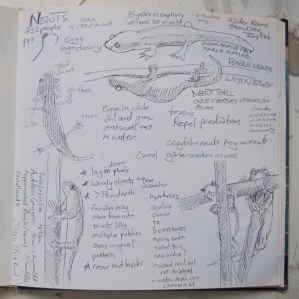
my lecture notes for Karen Goetz's lecture

I now know at least a little bit about newts. Karen Goetz, with beautiful photographs,  introduced us to the natural history of the California Newt (Taricha torosa). Karen, as part of her graduate studies in Conservation biology, had studied how female newts selected their egg laying sites in the hills of the East Bay.

She lead with the life cycle of these amphibian’s (a type of salamander in fact): from their start as eggs the size of o large cherry, through their larval stage on into their adult life, their mating habits, and how they lay eggs, growing 6-8 inches, with toxins in their skin, and living for a surprisingly long time (20 years at least in the wild, with a record of 35 in captivity). Despite their toxic skin, they still have their predators, crayfish and garter snakes, and other newts as well.

What Karen had studied in particular was where the female salamanders lay their eggs. It turns out they tend to lay their eggs in deeper pools (greater than 37cm in depth), on woody objects of 9mm diameter or greater,  near muddy banks. Her hypothesis being that their choice relates a lot to biomechanics — how eggs fare in the seasonal flooding of California creeks: eggs fare best when laid on woody branches resilient to turbulent waters, and deep enough that they would avoid being hung out to dry before the eggs hatched.

Her pictures from under the water were ethereal glimpses of the lives of these animals. Probably the part we know best, as when they crawl out from the creek, there’s not a lot of data of how far, or doing what. We do know that newts, like many other amphibians, are vulnerable because they are so dependent on water for such a crucial part of their life. Humankind has had a huge impact in what it has been putting into the water, as well as how the water flows.
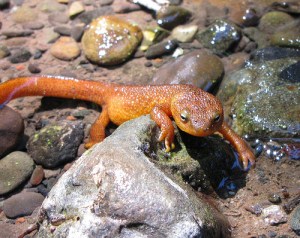
If You Knew Newts Like I Know Newts
Guest speaker: Karen Goetz
7:30pm, Thursday, October 22nd

Karen Goetz introduces the natural history of the California Newt (Taricha torosa) from their egg laying in local streams to larval hatches and metamorphosis.

Karen studied the California Newts as part of her thesis work for an M.S. in Conservation Biology in 2005. She studied egg deposit site selection preferences at the microhabitat level in creeks in the Berkeley Hills.

Join us to learn what she knows!

California Newt

Philip has starting booking speakers for 2010, and we are excited about our first speaker for next year.

Camilla H. Fox is the Founding Director of Project Coyote, a national non-profit organization that promotes educated coexistence between people and coyotes and advocates on behalf of all native carnivores. Her presentation will cover coyote ecology and biology in urban and rural ecosystems, coyote-human coexistence, coyote conflict management and the value of community-based conservation approaches.

Ms. Fox will also show Project Coyote’s (in partnership with Living World Films) new documentary American Coyote ~ Still Wild at Heart. The thirty minute film produced by San Francisco based filmmaker, Melissa Peabody, is a virtual case study of the coyote’s natural range expansion continent wide. While the film unfolds with the return of coyotes to the San Francisco Bay area, it pursues the coyote’s story across the North American landscape – from Northern California to New York City’s Central Park to Chicago, and points in between.

Ms. Fox a wildlife consultant and holds a Masters degree in Wildlife Ecology, Policy, and Conservation from Prescott College. With over 15 years of experience working on behalf of wildlife and wildlands, Camilla is a nationally recognized leader in her field with expertise in native carnivore conservation and human-wildlife conflict mitigation. A frequent speaker on these issues, Camilla has authored more than 60 publications and is co-author of Coyotes in Our Midst: Coexisting with an Adaptable and Resilient Carnivore and co-editor and lead author of the book, Cull of the Wild: A Contemporary Analysis of Trapping in the United States.

More information about Project Coyote.

Liam O’Brien would like San Francisco to be remembered for more than the first known eradication of a butterfly species from the planet. The Xerces Blue went extinct in the 40s due to urbanization, and possibly because of the popularity of the butterfly in people’s butterfly collections in Victorian times. He would like to see the Green Hairstreak survive on the hills of San Francisco.

Liam took us through the biology and ecology of butterflies and why they can be so susceptible to human interference. Butterflies have host plants on which eggs will be laid, and some species including the Green Hairstreak is very particular (Deer weed and coastal buckwheat). Further, butterflies have a nectar source, and here again the Hairstreak is a picky eater of Wild Cucumber and Seaside daisy.

The butterflies only fly from 8-10 days in March through Mid May. The length of the season depending on the amount of spring rain. The larva sits in leaf litter for months before it pupates. The hairstreak is also one of 15 species in San Francisco that is a hill topper. Around 3pm in the afternoon the butterflies will fly to the top of one of the few hills they congregate looking for a mate. The females then disperse.

In an urban world this is the danger point for butterflies, especially the Green Hairstreak females looking for a spot to lay their eggs.

This where the Project comes in, trying to create corridors of habitat for these little minute creatures. Organizing people to grow and plant the host plants and nectar sources that will allow this “charismatic micro fauna” to survive. In this little project there is now a community of people who are coming together to plant a community of plants that will keep a community of animals.

Hopefully this can be a model for some of our other native species, and in the process bring us back a little of what we have lost. To find out more, check out their page on Nature in the City.

The Green Hairstreak Project
Guest speaker: Liam O’Brien
7:30pm, Thursday, September 24th

The Green Hairstreak Project is a conservation effort of the Nature in the City organization and Liam O’Brien to connect two of the last remaining populations of a rapidly disappearing butterfly from San Francisco – the Coastal Green Hairstreak.

You can read more about the project, on the Nature in the City website, at www.natureinthecity.org/gh.php.

Please join us at the talk!

Using photography, old maps, and any scrap of archival information they can find, Robin Grossinger and his colleagues at the Historical Ecology Program of the San Francisco Estuary Institute piece together what San Francisco Bay Area landscapes used to look like. In trying to solve climate change and other environmental issues, can we calibrate ourselves better with the california landscape better than we currently do. As much as we have collectively changed the Californian landscape, especially in the last 60 years, the landscape has never really gone away.

From the distribution of oaks and other trees in the bay area, to interior marshes, to beaches in the bay and the way creeks flow down into the South Bay, it seems like there is things that we could do a lot better.

The value of seeking to return areas to their former state is not from a sense that “more natural” is better, but that it can be a pragmatic and worth doing from a cost savings perspective, working with the landscape rather than fighting to change it. Restoring wetlands which could help with flood control, not trying to turn intermittent streams into perennial ones that we constantly have to dredge, and for which we have to import water to keep running.

Of course, the problems are now complicated by our growth and how we have changed things. One example of the complexities that we have created is the steelhead salmon runs that go up rivers in the South Bay… Salmon that can no longer return to the delta partly because so much water is pumped away from it — to ironically feed these kind of rivers.

We can hope that the work that Robin and his colleagues are doing can help lead us to a better path to living within our environment.

Historical Ecologist Maps a Changing Landscape
Guest speaker Robin Grossinger
7:30pm, Thursday August 20, 2009

Drawing upon recent studies throughout the region, Robin Grossinger will illustrate the regional diversity and common themes of historical Bay Area landscapes, and potential restoration strategies they reveal.

Robin Grossinger is a scientist at the San Francisco Estuary Institute, where he directs the Historical Ecology Program. For the past 15 years, he has studied how landscapes of the Bay Area and California coast have changed since European contact.

More information about the Historical Ecology Program: www.sfei.org/HEP

Peter’s talk took us across the Pacific Ocean, following the stories of a few remarkable animals. Two in particular.

He started with two species of albatross that live on Midway island. It was a bit of a puzzle why and how these two closely related species lived together so closely. The albatross for a long time was seen as a problem and the Navy waged war against it until they figured out how to coexist (the albatross managed to do well enough in the battle that a statue was erected in its honor).

The scientific mystery was not solved until they tagged the animals as they left their chicks behind to find food. The chicks are mostly safe and sound on the island (the Navy aside) with not predators, but little nearby food. What the scientists discovered was that the animals flew thousands of miles to feeding grounds, and that is where the species separated: one flew to the Bering sea, the other flew to California.

Parent albatross leave their chicks for a month at a time taking 4 days to fly to near their destinations: upwellings where they could store up on the food they needed for themselves and their chicks. Nearly 7,000 mile round trips. The birds become flying “fat bombs” converting their food to an awful smelling oil that is hard to remove from one’s hands. The birds are also built for the long distances, with their long wings the wind can carry them the whole one way distance without flapping a wing, perhaps even sleeping on the wing.

Equally surprising was what Peter Pyle and his colleagues found with sharks in the Farallones. Peter worked their studying birds, but soon became fascinated with the local sharks (only confirmed after 1980 that they were Great White’s) working to study and protect them.

When they started tagging sharks they found the sharks were swimming thousands of miles. Some would appear regularly in Hawaii, almost all of them would spend some time in a random place in the South Pacific (a mating area most likely, but there doesn’t seem to be any good reason for the spot — perhaps it is some deep deep ancestral spot where there used to be a coastline, sharks being one of the older species on the planet).

They also found that there was a difference between males and females. Male sharks would be gone a year, but females would be gone for two. It’s suspected that the female sharks give birth to their young on the other side of the Pacific, before they make their way back.

He ended the talk touching briefly on a few other journeymen species: leatherback sharks swimming from Indonesia to California (as we’d seen in an earlier talk from this year) and the Bar-tailed Godwit flying some 13,000 miles in its migration to New Zealand.

Astonishing journeys, reinforcing some how little we know about some of the animals that we share the planet with, even some animals like the Great White Shark that we obsess over.

The Great Transpacific Migrations with Guest speaker Peter Pyle
7:30pm, Thursday July 23rd, 2009

This talk will be about the Great Transpacific Migrations from albatross to turtles, from sharks to shorebirds. Wildlife biologist Peter Pyle will share recent discoveries using satellite tag technology showing some of the amazing ways animals migrate across the Pacific.

Peter is a research scientist who currently works for the Institute for Bird Populations studying changes in North American bird populations. He spent 24 years as a Farallon Island Biologist for the Point Reyes Bird Observatory studying bird, bat, and butterfly migrations, as well as great white sharks.

Mike Boom gave us a fantastic introduction to the ecosystems off California shores. He started with an amusing pantomime description of what it takes to suit up and equip oneself to make his underwater videos.

The video camera itself was surprisingly normal looking for the stunning results he had on screen. He started with Southern California waters off Catalina Island, showing us from plants, to invertebrates, to fish the host of creatures that inhabit the seas. He left us with a litany of names that probably only scratched the surface of the water’s diversity, but the images brought oohs and aahs from the crowd.

His second segment showed us the waters off Monterey, with a similar progression of creatures — noting how the waters differ in plants and animals and how they are similar, as well as noting the difference in water, how southern waters can be much clearer if only a little bit warmer.

He ended the night with two extra little clips, one showing waters even further north in Alaska — again bringing out the differences of life as water gets colder (creatures from the deep in the south tend to show up at higher depths); the other showed a chance encounter with a juvenile seal which was a delight to watch. First shy, then coy, then outright showing off its splendid mobility in the waters — every now and again stopping for a scratch.

Check out some of his videos (from waters above and beyond Californias) at laughingeel.com.