Feeds:
Posts
Comments

Archive for the ‘Lecture Notes’ Category

The good news, according to redwood ecologist Dr. Emily Burns, is that climate change seems to be working in Redwoods favor — for the moment at least, doing a lot of carbon sequestration. Over the last century growth rates are increasing for Redwoods all over California but Northern California in particular. No one knows the answer but leading answers are longer growing seasons, less fog/more sunshine, and more CO2. 

But it’s difficult to say if that will last, or it will be good in some places and bad in others, the Redwoods live amongst and between many microclimates. Redwoods demand a pretty high volume of water — and if the amount of fog continues to decrease (fog has decreased by ~33% over the last century) it’s hard to say when redwoods might feel the pinch. Scientists do not know what the tipping point would be.

Redwoods, and 80% of the plants that live within a redwood forest, take in much of their moisture through their needles and leaves through a process called foliar uptake. The amount of water they get is dependent on how much fog sticks around, but the process is readily visible if you are climbing into a redwood when the fog comes in — as Dr. Burns attested from her experience up in the trees.

Overall, the last 144 million years have been a rough period for redwoods. There has been a massive reduction in their population since the Jurrasic, their range contracting due to a combination of geological and climatic changes. Of course, the last couple centuries has seen the last remnants of redwood forests under immense pressure from mankind’s agriculture and urbanization.

The 2009  Redwoods and Climate Change Initiative has set out to study the last 30 years of Redwood history, and compare it against the 1900-1980 historical baseline that we have, to try to make predictions, and understand the patterns that are driving change in the area — and how that will affect Redwoods. This is done through historical records, but most importantly the redwoods own record — it’s tree rings.

Tree rings give a picture of how a tree has done over the years. Tree ring studies have been around a long time, but redwoods are notoriously difficult. Researchers have taken care to take cores from different heights, and cross reference them both across the tree and across forests looking for patterns.

One thing that they’ve been able to see with these kinds of studies is how trees respond to droughts and floods. The tree record shows that the response is immediate. All this data is being submitted to a national archive, and plans are afoot to compare data across species.

Researchers are also measuring branches — 40% of growth occurs in branches. And these big trees can grow! The superstar tree is the Emerald Giant which produces wood sufficient for 2 million pencils in a year. Once they thought old trees grew slower because their tree rings got thinner — but it turns out it is just the tree putting more wood over a greater surface area. Old trees it turns out, grow faster.

Of course, climate change also affects more than just the Redwood tree, but the whole Redwood forest ecosystem. Maybe the trees grow well, but what if the rest of the forest plants don’t cope as well… what would happen then. The forest is a very complex ecosystem — and there is a lot more data to be had.

Dr. Burns invites everyone to join in to help with the Redwoods. One simple thing, is to help find them all — look for the Redwood Watch iPhone app.

You can also find out more about Dr Burns work at her website, or by following her on twitter.
Read Full Post »

Filmmaker Lance Milbrand — who spoke with us on November 21st, 2013, has some pretty amazing footage: newts paddling through a stream, hanging from twigs, laying eggs, newt eggs hatching. Some of this is in some part due to the amazing technology we have on hand to film, but to a larger degree it comes from Lance’s patience and persistence — laying still in a cold stream in a dry suit, camera at the ready, working to get the shot he wanted.

He showed three films that night — one about a recent trip to yellowstone, with bears, rutting elks (the more dangerous beast), a hunting coyote, and a beautiful landscape; two films about newts — a children’s music video (see end of post) and a portion of a longer piece about the newt lifecycle.

The patience and persistence doesn’t necessarily end at the camera — there’s is also editing, and of course distribution. We hope that Lance finds a way to finish this great little educational film about these strange little creatures, our neighbors here in the San Francisco Bay area.

You can find more about Lance and his films on his website: milbrandcinema.com

Read Full Post »

I’ve always loved the story of Agassi and the fish, where a prospective student of his has his powers of observations tested by a dead and rotting fish.

Having been an avid observer of birds of over the years, I was blown away by the amount of what I did not know about birds. David Lukas’ lecture explored the bird from the inside out, exposing a lot of the critical tweaks of evolution that allows it to do its most arguably bird-like activity: fly.

bird bill mechanics

With a overhead projector, transparencies, and a dry erase pen, David lead us on this exploration — starting from what we in the audience knew of what makes a bird a bird. A lot of what has driven bird evolution is around the ability to fly: reducing weight, balance, and increasing power.

Power is most obvious in its muscles — a birds breasts muscles are around 30% of the birds overall weight.

Reducing weight has led to hollow bones, a lack of teeth, gizzards in the middle of the body at the bird’s pivot point where their food is ground up. They have a fast metabolism which processes food in 15 minutes, and dispose of waste as uric acid which doesn’t require a bladder.

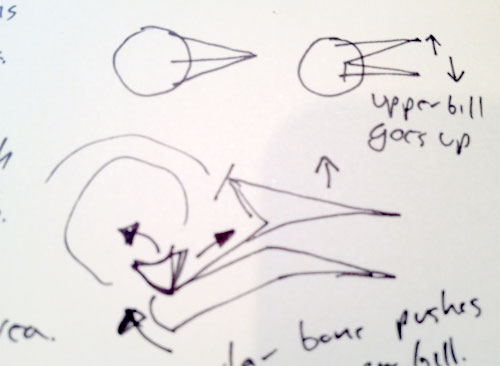
The bird jaw and feet have mechanical mechanisms for serving the bird’s needs. In opening the beak — the upper beak is pushed open when the lower beak is pulled down. This limits the number of muscles needed for the bird because muscles = weight. The action of sitting, folding the legs, curls the toes of the bird — this is what allows the bird to sit overnight on a branch without sweating it. Some raptors take advantage of this when they take down prey, they’ll land and seem to smother their prey — what their doing is taking advantage of this mechanical action to add a killing below to their strike, closing their talons just in the act of landing.

The ribs — which are small jointed fragile bones — act as a bellows for the bird, pumping air through the body. Some of the birds hollow bones (which in general are not all that fragile) also play a part in the bird’s respiratory system, helping in the transport of the air between throat, air sacs (front and back), and then out again. This one way path of the air also helps in keeping the bird cool (birds run hot!), acting as a heat exchange throughout the body. Everything is built for maximum efficiency.

Wings and feathers are whole other pack of fascinating details from the way feathers grow and overlap and have different functions: down for insulation, feathers for flight (and also a degree of waterproofing with their overlapping and interlocking barbs and barbules), and little filoplumes sticking out through the other layers of feathers to provide some additional sensory inputs to the bird. David have the image of someone dressed in a down coat with a Gortex jacket worn on top — they would not otherwise be able to feel the air.

A surprising little detail of feathers though is that feathers appear in groups, with most on the head. The body itself is mostly bald with feathers combed over to cover it.

There seemed to be no end to the surprises from their huge eyeballs, to their tips of their tails, all these little details that make birds what they are — another lesson in how little I know about the world, and how fun it is to learn.

You can find out more about David Lukas, his books, and upcoming presentations on his website lukasguides.com.

Read Full Post »

More Than Just a Mound of Shells

Perry Matlock joined us on Sep 19th to talk about Ancient Monuments and Funerary Places in the San Francisco Bay.

When the word “shellmound” comes to mind, the first picture in your head is probably that of a garbage pile, a midden heap, a pile of refuse, or dinner table scraps – a big pile of empty discarded shells. This is the remnants of the dismissive thoughts of the archeologists who first looked at them.

There are other things in the shellmounds: fish remains, bones & scales, charcoal residue, which might add to that picture. But the significant find is that the mounds often contain human remains. With that simple fact, we might thing of them quite differently not as a pile but a place – burial mounds, sacred places, akin to hallowed places round the world: the geomorphs, mounds, earthworks, and stones that are quite often protected and preserved with maps and guidebooks pointing them out.

Now the numerous shellsmounds that could once be found all over the Bay Area (425 according to one 1909 map) are almost all gone. Some of the mounds, like the one in present day Emeryville were huge, thousands of years old – likely landmarks. Most of them have now been destroyed dug up, bulldozed, sometimes dynamited used for roads or tennis courts, garden beds, or just to get them out of the way.

It was only with the dismantling of the Emeryville shellmound that the issue of the dead came to the forefront. Local Native Americans and allies did their best to bring the issue to the forefront. They lost that particular battle (Emeryville has a little homage to the mound, which can’t really in any way make up for it) but it brought together the right people to start saving those mounds that were still left.

There is still some mystery as to what larger purpose these mounds had, how exactly they were used and played a part in everyday life. One interesting note is that Coastal languages done’t have a word for shellmound — or possibly just not telling it to anyone. Whatever we know or don’t know the local tribes consider these places sacred — which really should be enough.

If you are interested in learning more one place to check out is the Oakland Museum of California – their new exhibit on the Bay (Above and Below) has a section on Ohlone life prior to the Spanish.

I will add links to additional resources and books that Perry mentioned in his talk to the website. Perry was not speaking as a representative of any tribe, but only for himself having been involved and volunteering on these issues for many many years.

Read Full Post »

Mountain Lake

The last 60-70 years have not seen Mountain Lake in the Presidio treated well. When the Spanish came across it in 1776,  Father Pedro Font wrote:

“This place and its vicinity has abundant pasturage, plenty of firewood, and fine water, all good advantages for establishing here the presidio or fort which is planned. Here and near the lake there are yerba buena and so many lilies that I almost had them within my tent.”

The lake changed most drastically when Highway 1 (Park Presidio) was put laid in. Sediment from the tunnel through the Presidio was dumped into the lake, and drains from the highway, sent oil and gas directly from the road into the lake. Once 20′ deep, its depth was lowered to only now 9′ at its maximum, and became slowly but surely full of lead.

Add to that the acid and tannins from leaves from the abundantly planted  Eucalyptus trees, all sorts of odds and ends (including a carriage according to one member of the audience), and all sorts of turtles, frogs, fish and other critters (including in 1996, a Cayman alligator), the lake has changed dramatically from when Father Pedro found it.

Much of the talk about restoring the lake started when the lead was first noticed by a scientist in the 90s (and later affirmed by various agencies). People also were worried about the increasing murkiness of the lake.

Two efforts are being made to restore the lake: one is to get rid of the lead, and at least some of the sediment that was dumped there. This involves filtering sludge vacuumed up from the bottom and pumped up into bags which will are being taken to a landfill. This will also remove some of the accumulated leaf litter. Some of the eucalyptus is also being removed to reduce the amount of impact they have on the lake (many trees remain near the lake as part of a “historical forest”).

The other effort is to try and restore the lake back to more like what it once was. This involves two fairly difficult task: one is to remove the invasive species and relocate them to other places where they will not have the same impact. Already about 40 fish (carp, bass, and a couple sturgeon) and 17,000 juveniles have been removed, as well as numerous turtles. In case you are worried, these have been taken elsewhere to live out there lives — the fish to a private lake, the reptiles to Sonoma County Reptile Rescue.

The other, perhaps most complicated task is to restore native species back in the lake. This is not just animals but also plants. One group of people will be setting up a set of compatible plants species, the others will focus on bringing into the pond species that will, should, and can thrive. This is complicated not only be the problems of individual species, but also the status of endangered species and how they can be treated. Another factor — at least where amphibians is concerned is the Chytrid fungus that is having a devastating effect on many amphibian species.

It is a long term effort that will require vigilance, testing, and monitoring to make maintain the appropriate balance The depth can’t be restored to it’s prior depth because of the risk to the roadway , so pumps are also going to be utilized at least until some of the plant communities take hold.

It’s a little bit akin to a gigantic aquarium project, where you’ve had to start out with a filthy tank full of species that you are not particularly interested in.

Why go through all this work to try and re-establish this ecology? To preserve and protect biodiversity — and all the ecological functions and stability that biodiversity can provide; to test the theories and experiment with introduction frameworks of how these restorations actually happen; and last but not least to provide environmental education — engaging the local community, to bring an awareness of our urban ecology and how we interact with nature in a city, and to be a living museum for all these marvelous creatures.

Read Full Post »

Listen Carefully

http://www.nature.nps.gov/sound/data.cfmDan Dugan’s Nature Soundscape Lecture (July 18th) was the first time we’ve had a speaker in a couple hours before the talk began to set up. The auditorium was filled with a couple miles of cable, and a loud hissing as — he and a helper calibrated 4 speakers for our listening pleasure. And pleasure it was: a raven quorking its way through redwood trees, rocks crackling, mud bubbling, ice cracking, wind howling through palm trees, frogs croaking, 3 separate flocks of birds successively launching into the air, bats crinkling into the air from lava tubes, and the same bats humming back home later, coyotes singing, Lassen, an overflight of geese wings buzzing, elephant seals grunting and clucking through the sound of surf, the booms of spring ice falls in Yosemite, a chorus of jays in Muir lake, and the sounds of Mariposa Grove.
These were examples of geophony and biophony — sounds of the earth and the biosphere — terms introduced by Mr. Bernie Krause a local soundscape analyst. The importance of soundscape has only come to our attention in the last 25 years and how anthrophony — the sounds that we humans make — can impact ecologies. Our sounds reduce the amount that predators and prey, and mates and friends can hear.

The National Park Service established soundscapes as an official resource in 1999, and have been taking inventories, monitoring changes, and drawing up plans. 6 people in the National Sounds & Night Skies Office in Fort Collins run this effort – lending out gear for parks to monitor their soundscapes.

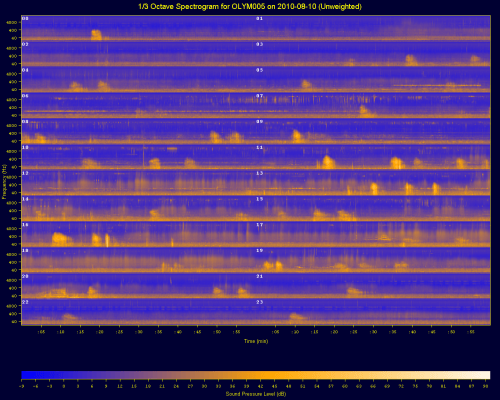
These monitoring  stations produce spectrograms that show sounds over the course of a day. From this all sorts of things can be picked out:  bugs, birds, the dawn chorus, and all the anthrophony: mostly aircraft — but you can tell helicopter, from jet, from prop plane. These become important in how Parks then manage overflights from private tourist companies, but also passenger jetways.  High altitude jets leave a sound “trail” 30 miles wide. This kind of monitoring has had some impact where in some places aircraft have been limited to certain altitudes, defined lanes, and only certain hours. There has now been discussion of making some parks no-fly zones.

Dan lead us through a lot of the techniques and tools by which his recordings were made. The types of microphones used for different things, the methods of capturing sound: mono, stereo, or surround, how our perception works with these different techniques, and the set up of all those things to effectively catch sound. Delivering these beautiful sounds though doesn’t stop with the recording — which is arduous in itself: hauling in the gear (he has lightweight gear for going further), getting up early to capture the sounds, finding the right place at the right time. It requires a good deal more work in the studio to polish those sounds up and combine recordings. (If you want to know more about this, I recommend signing up with the Nature Sounds Society for more info.)

He led us through a fun exercise looking at a sound spectrogram, and then hearing it — looking for the patterns of all that we were hearing (it was from a rainforest in Costa Rica — so there was a lot going on). The best part of the night was the fruition of all that work — listening with our eyes closed to the beautiful sounds around us.

Read Full Post »

Sunset History

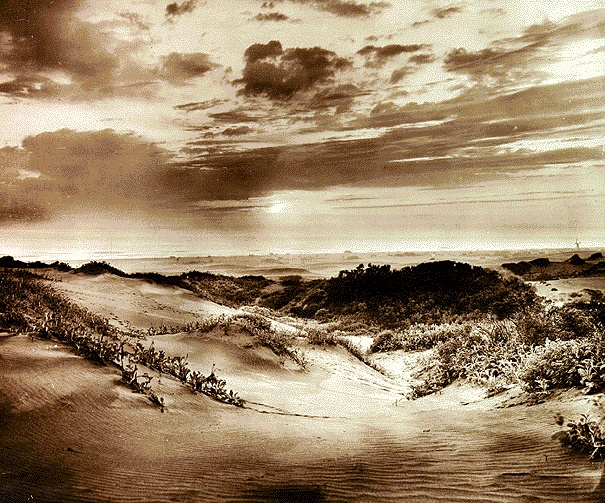
Outside Lands - Photo: Greg Gaar Collection


Photo: Greg Gaar Collection (approximately 1900 — note the windmill in the upper right)

We San Franciscans can be a bit dismissive of the Sunset (and the Richmond) where Golden Gate Park is not involved. Lorri Ungaretti gave the truth of it in her lecture on June 20, 2013: Stories in the Sand.

Before it became to be known as the Sunset, the area was known as the Great Sandbank, and the Outside Lands. It was sand and more sand, dunes, and dunes covered with vegetation. Think of the area just north of Monterey and Seaside, Sand City, and imagine that stretching a good deal further.

It wasn’t part of the city until 1866, when the land was granted to the city after a supreme court decision. The quickly growing city had started to think about development. After the land was granted, the city quickly started to draw up plans. From the beginning, plans for a great park were decided upon, and 4 years later, they began work — the first efforts to smooth out the dunes of the sunset.

The midwinter fair of 1894 was a big deal in the development of the area.  Bringing both public transit and public attention towards these empty lands. Development was slow at first, Carl Larsen owned a lot of the land, including a chicken ranch.

Old horse drawn streetcars were dumped out by the beach, and these became known as Carville by the sea, as first people used them as clubhouses, then as homes, increasingly elaborate ones, as people stacked them, and made courtyards. Eventually there was a hotel and a church. By teens and 20s they were falling apart, as people began to build more permanent homes. By then the area was known as ocean side.

The first developer was Parkside, who began laying out roads, and bringing out more public transit. Other builders started to move in, R.F. Galli, Oliver Rosseau, and the biggest of all Henry Doelger (aka, per Herb Kane: the last builder of affordable housing, one nail henry). The 20s and 30s saw the dunes disappear under the development. The sand did not totally disappear though — the pioneers (as Lorri referred to them) had a to deal with blowing sand that made gardening difficult, and leaving your car outside a danger.

Of course, things were not perfect — all these developers were intent on keeping Asian-Americans, and African-Americans out of these developments. These policies were not successfully challenged until the 60s (Willie Brown was the origin of one protest after he was not allowed in to view a property), when the Prop 14, the Fair Housing Act (which was protective of these racist policies) was ruled unconstitutional by the US Supreme Court.

Lorri profiled a few notable people who helped shape the neighborhood: the chicken farmer Carl Larsen who originally owned much of the land, Ray Schiller — “the mayor of Parkside” — a neighborhood activist and community organizer,  Josephine & Audley Cole — Josephine was the first African-American teacher in SF public schools, and Audley the first African-American MUNI driver, and the professional tennis player and WWII spy, Alice Marble.

There’s plenty of more to learn. Check out Lorri’s books, and numerous articles. Check out her website for a full list of books and articles.

Read Full Post »

Michael McGowan spoke before the Natural History crowd on May 16, 2013 about his thinking and philosophy around invasive species in the San Francisco Bay.

Our current attitudes to managing invasive species come from Charles Sutherland Elton who brought this sub-discipline into being after the Second World War. He recommended quarantine, eradication, and controls to suppress invasive species. The chief goal of which was to prevent extinction of native species and a homogenization of the local ecosystem.

There are many examples of where invasive species have wrought havoc on local ecosystems. Many of these examples involve islands, where species diversity is already low. And there are places like Australia where there are many examples of introduced species gone wrong.

What can we say about the Bay, in this regard? There are any number of invasive species: striped bass, oyster drills, mitten crabs, clams, cord grass, various copepods, and a mud shrimp species that Michael only recently discovered. These have been introduced intentionally, and unintentionally and have all in some degree affected SF Bay, at the same time there have been changes wrought to the environment by man through other means: run-off from gold mining, the filling in of wetlands, the run-off from our growing towns and cities, ship traffic, damming and altering of rivers, climate change, etc.

One question then is how much harm have these invasive species brought to the bay? Of the species Michael went through, the Corbula clam may have had the greatest affect altering the processes of the North Bay, but there has been no species extinctions as a result of these species, and no homogenization of Bay diversity. In fact, one could say that the diversity of the Bay has increased, that there’s been some net gain.

That isn’t to say we shouldn’t try to preserve & protect native species, or introduce new species willy-nilly, or not worry about things like ballast water (the standard practice these days is for ships to exchange ballast water offshore where travelling species won’t be released into more protected waters). Michael stressed the importance of good data and monitoring over time to work towards understanding these complex systems on top of which we are living.

Read Full Post »

A Crown of Herons

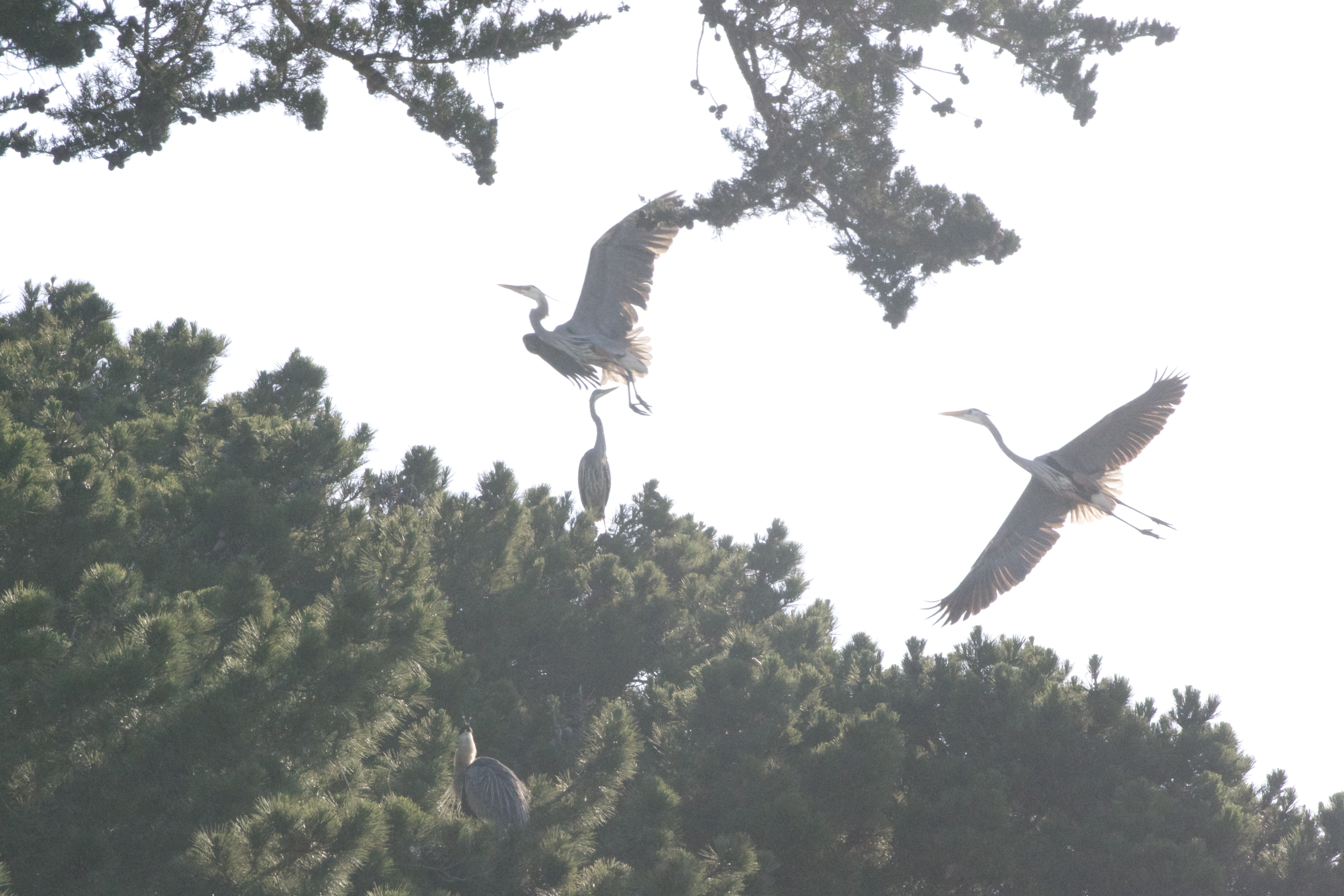
Great Blue Herons at Crissy Field

20 years ago, Nancy DeStefanis, was at Stow Lake and was lucky enough (although one imagines a keen eye probably helped) to find Great Blue Herons nesting at Stow Lake — the first Great Blue Herons recorded as being seen in the city in fact. Every since, then she has been following these big beautiful birds as they come to breed, nest, and rear their young. The pictures she presented at our lecture on April 18th, 2013, presented a shorthand version of their lives in and around the nest. (Forgive me if I get some of the details wrong — I was running the slideshow and not able to take notes.)

The males arrive first as a Christmas nest, looking to stake a claim on the nests left behind from previous years, waiting for the arrival of their mates. When the females arrive nest building starts, the males presenting sticks to be added to the ever growing nests. This leads into the courtship, and eventually mating. The eggs are small, only slightly bigger than chickens eggs, but the nestlings that hatch quickly begin to grow. The mother and father bring food to the nest, but don’t necessarily feed the chicks through regurgitation.

Great Blue Herons not only snack upon fish, they also hunt gophers and other rodents that populate our parks. Not much preys upon Great Blue Herons in turn although Great Horned Owls have been known to hunt them at times. There are 4 nests currently being used on the tree, but there is about 6 total. The most prized on is near the top of the tree, of enormous size as it has just been added to over the years. One nest fell off the tree at one point — which has since ended up at Audubon Canyon Ranch.

The young herons sitting in the nest are wonderfully silly to behold sporting black mohawks that get tossed about in the end. The birds quickly grow though and it is only some weeks before they are nearly as tall as their parents and are stretching their wings, and beginning to hop from branch to branch.

After the birds fledge, the birds go they own way. The juvenile young herons at this point are on their own. Parents don’t teach the young. Their survival rate is very low. 67% don’t make it past their first year.

You have a couple more weeks to be able to see the birds with the aide of Nancy and her crack crew of volunteers and great spotting scopes. At 1030am she walks her guest around (young kids are free, adults are $10) the lake and over to the Strawberry hill, looking at not only the herons, but with an eye for the other nests and species that inhabit the park. It’s well worth a trip — head over to the Stow Lake boathouse, and look for Great Blue Heron signs.

Read Full Post »

Underfoot

As you walk about the hills of San Francisco, you can consider many things: the blue sky, the fog rolling in, the birds tweeting about you, a beautiful building, a tree, a garden, the fabulous inhabitants. Even living in earthquake country, it is easy to think of the ground under our feet as something immutable. Dr. Jean DeMouthe, Senior Collection Manager at the California Academy of Sciences, on March 21st, 2013, brought us around to thinking about what and how the rocks of San Francisco came to be under our feet.

Fifteen thousand years ago, one could walk to the Farallones Islands, the golden gate a river . 125,000 years ago, San Francisco was an island, Lake Merced a remnant of the Colma Straight. The rocks of those days were “forged” much much earlier as the pacific plate crashed into the north america plate, subducting under it, and giving rise the the volcanoes in the (now) east bay and to the north. Out of that, and the movement of plates came our main rocks: serpentenite, chert, and sandstone. Our serpentenite (not as nice looking as in other areas of the world) is a metamorphic rock formed under heat and pressurel; chert is remnants of biological activity — shells of radalarians that accumulated on the sea floor, and buried, and under pressure solidifies the silica in the shells recrystallizing, separated by layers of clay and siltstone; our sandstone is graywacke, the weathered remains of volcanoes washed out to sea. The latter two, laying as they did on ocean floors, owe their place in our hills due to the movement of earth.

Today the subduction is done, the plates now moving in opposite directions (there’s still subduction going on in the Pacific Northwest part of the “ring of fire” around the Pacific). But those rocks are now with us (at least for our short stay on this world) and help give rise to the unique landscape of our city. Serpentenite, for instance, is detrimental to most plants, it is poor in calcium and magnesium, the opposite of what most plants need to thrive, but of course evolution comes in to play and there are plenty of endemic species that survived the harsh climate and adapted to the conditions.

Not much of our rock was particularly good for buildings, (like our wood presumably) a lot of that rock came other places where there was volcanic rock to be had like from Marin. In other places, serpentinite might have been used as a decorative piece, but ours is not as pretty as some.

Our city is dotted with little rocky outcroppings, along the shore, at the tops of many of our hills. You can see the layers thrust up and out by the movement of the earth. If you look closely and in the right places, you might see the remains of other processes, rare materials, and fossils (be warned that it is not longer legal to take, so just look!).

Read Full Post »

« Newer Posts - Older Posts »