Feeds:
Posts
Comments

Keeping Nature in the City
Guest Speaker:  Peter Brastow
7:30pm, Thursday, October 20th, 2011
FREE at the Randall Museum, 199 Museum Way, San Francisco, CA 

Nature in the City’s founder Peter Brastow shares his vision of how we can more meaningfully interact with the wild in our city: restoring natural areas in our neighborhoods and backyards and through projects like the Twin Peaks Bioregional Park and the Green Hairstreak Corridor.

Peter Brastow founded Nature in the City in 2005 with the idea of connecting urban people to where we live. Doing this would help the growing movement to conserve San Francisco’s natural areas and biodiversity, helping to carry ecological restoration and stewardship further. Peter had previously served as the Presidio’s National Park Service Ecological Restoration Specialist.

You can read more about Nature in the City and their projects at natureinthecity.org.

A Changed Landscape

To a packed house on September 15, Greg Gaar gave a great tour through the history of San Francisco with his collection of slides.  The land on which our city sits has irrevocably changed through the hand (and machines) of mankind. There were dunes, lakes, coastal prairies, tidal bays that today are gone, or were buried beneath the expanding city. The sands of SOMA were used to fill in the waters of Mission Bay. Creeks now run underneath our streets, the native trees long since cut down and replaced with the Eucalyptus.

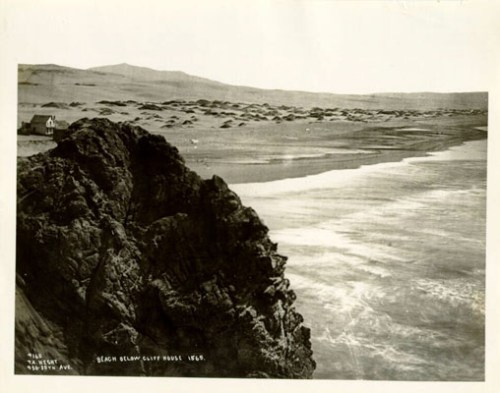
Ocean Beach and san dunes

Beach Below Cliff House 1865

Sutro was apparently one of Greg Gaar’s childhood heroes, only later did he realize the damage that the huge groves of tree have done. To highlight these he contrasted a Eucalyptus forest in Australia to one here. The one here was dominated by one tree and two ivys, it looked nothing like the Australian forest.

The story is as much a social one as a natural one: with tales like Sutro’s, but also involve cemeteries, grazing, private water companies, railroads, laundries, butchers, and now restorations. Greg also gave us a tour of the 32 Natural Areas that are spread through the city, and while there are many challenges they is also hope. The restoration of Heron’s Head with its recently spotted Clapper Rails being a highlight, but overall it is an exciting time: we now know how to repair biological systems — and can repair them.

There is also a hopefully growing appreciation of nature: when the sea lions first appeared at Pier 39, people wanted to get rid of them. It’s hard to imagine that mindset now.

Greg encouraged us to imagine other possibilities, no matter how seemingly outlandish. We cannot site back and let the planet go to ruin at our hands.

San Francisco’s Changing Landscape
Guest Speaker:  Greg Gaar
7:30pm, Thursday, September 15th, 2011
FREE at the Randall Museum, 199 Museum Way, San Francisco, CA 

Greg Gaar will present over 100 historic images of the evolution of SF’ s native plant communities over the last 200 years. Greg will show the transition of our oak woodlands, sand dunes, coastal prairies, tidal marshes, lakes and creeks and efforts to preserve our natural heritage.

If you’ve seen any number of photos of San Francisco through history, chances are you’ve seen photos from Greg Gaar’s collection.

You can find many of them online, but also some also in a book San Francisco: A Natural History

Eggs and More

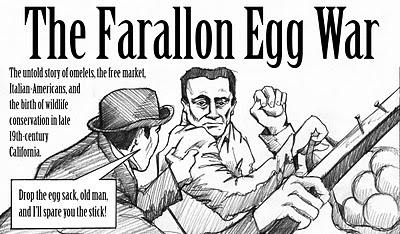
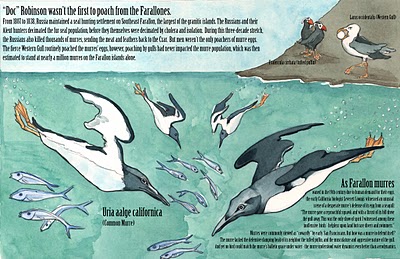
Garibaldi and the Farallon Egg WarEva Chyrsanthe gave us some interesting history lessons in August. It began with the fact that there were no chickens in San Francisco. Or not enough, anyway, to supply enough eggs to the growing town of San Francisco in 1849 and its visiting hungry miners. And with no eggs, no cakes either.

People knew of the Farallon Islands. Russians had hunted seals there. Russians at least were fond of the bird eggs. And they were plentiful. The islands are a fecund little spot sitting as they are on the edge of a great ocean precipice, the islands and its waters and the creatures therein and on fed by a great upwelling from the deep.

All it took was one enterprising person, and egg problem “solved”. That person was “Doc” Robinson. He and his brother in law went to the islands and poached (as in stolen, not as in cooked) $3,000 worth of eggs. At $1 for 1-12 eggs, that was a lot of eggs. And the pair had actually lost half their eggs in the rough waters of the Farallones.

The eggs were the eggs of the common murre. They are  2-3x the size of a chicken egg. They had a fiery red yolk, and although they did not keep to long, people liked the taste.

Robinson took his money and started a theater (Eva referred to him as the John Stewart of his day, as he wrote satires, and was often lampooning people), but others quickly took up his idea and the egg trade began.

The common murre eggs had two other things going for them: the shells were very tough so they could be stuffed into a vest safely, and the murres were easily driven off (unlike other residents of the island – western gulls and tufted puffins). That’s not to say the job was easy: Western Gulls were equally adept at thieving the eggs, and used the men to their advantage, often attaching the men. The poachers covered head to toe in guano often had to scale the cliffs of the island, and quite a few men fell–and although sharks tended not to be in the water when birds were nesting, the waters themselves are cold and dangerous enough.

The dominant force in the trade was the Pacific Egg Company (it had several aliases), but there were plenty of independent poachers, plus pirates, plus the Federals. The Federals were there trying to build a lighthouse, partly to save ships from shipwrecks, but also to lay claim to the island so Joseph Limantour couldn’t. The lighthouse keepers were often in conflict with the poachers (one lighthouse keeper, Amos Cliff, wanted the trade for himself).

The most famous conflict was in 1863 with a skirmish between independents and the Egg company that left 2 men dead. The company kept its upper hand until finally they were kicked out for attacking a lighthouse keeper. The poaching went on under the independents.

There have been some claims that the egg poachers were Italian mafioso, but Eva put those claims to rest. Not only were there not alot of Italian names in the Company rosters, most of the Italians were from Northern Italy, many political refugees and supporters of the great Italian revolutionary Giuseppe Garibaldi.

Regardless eggs were harvested. At the peak 500,000 Murre eggs were taken of the islands in 1854. The numbers fell through the end of the century, with 100,000 being taken in 1896. The biggest factor in the decline might be the growth of the chicken industry in Petaluma, starting in 1875.

But Leverett Loomis (the first director of the California Academy of Science) deserves the credit for putting a final end to it. Although he had a great respect for the workers, he didn’t like the work. It wasn’t until he reached the ear of Teddy Roosevelt that the poaching stopped for good (more or less, some small numbers were poached in years after)

[the Farallon Islands] are hereby reserved and set apart for the use of the Department of Agriculture as a preserve and breeding ground for native birds. It is unlawful for any person to hunt, trap, capture, wilfully disturb, or kill any birds of any kind whatever, or take the eggs of such birds within the limits of this reservation, except under such rules and regulations as may be prescribed by the Secretary of Agriculture.

This is Executive Order 1043 signed by President Theodore Roosevelt February 27, 1909. Chalk another good one up for Teddy as well!

Even with this long post, I can’t do the talk full justice. You can read some more about the topic in numerous places, but try here and this piece in Bay Nature by Juliet Grable. Stay tuned for more about Eva Chrysanthe’s book, Garibaldi and the Farallon Egg War.
The Farallon Egg War

The Farallon Egg War
Guest Speaker:  Eva Chrysanthe
7:30pm, Thursday, August 18th, 2011
FREE at the Randall Museum, 199 Museum Way, San Francisco, CA 

Writer and illustrator Eva Chrysanthe will present a re-examination of the political and market forces that led to mass poaching on the Farallones and the bold and ultimately successful efforts by 19th & 20th century scientists to preserve the island’ s ecology.

You can see more of Eva’s engaging illustrations on her blog.

Vanished Waters

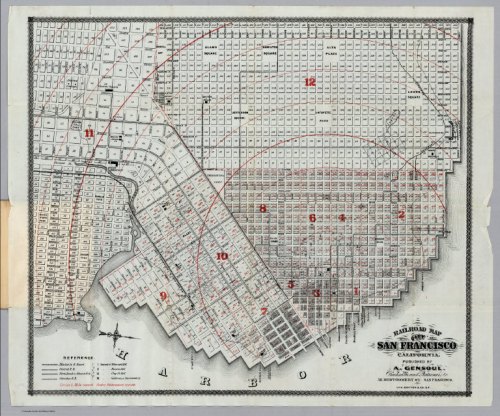
Railroad Map Of The City Of San Francisco

Railroad Map Of The City Of San Francisco

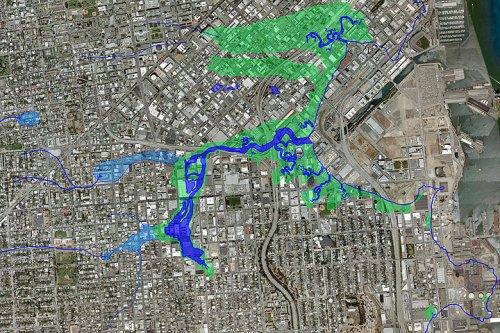
If were to rewind the Mission Bay area of San Francisco a few hundred years, we’d find a large shallow inlet of water, with Mission Creek flowing into it. Tidal marshes and 100 foot dunes would stand in what is now SOMA.

Vanished Waters tells the story of how that changed to what it is today. Chris Carlsson edited the second version of the book originally written by Nancy Olmsted for the Mission Creek Conservancy. He led us through the history of the area.

Of course, people have been there for thousands of years. The coastal area provided well for the Native American tribes who lived there. But in the last two centuries it changed rapidly from marsh, to agricultural land, to an industrial zone. The bay became smaller and smaller, the dunes pushed into the area as fill.

The Mission became a tourist attraction. The agricultural changed to gardens. Racetracks came about, then disappeared. Steamboats were built, all sorts of shipping from hay for city horses. The largest whaling port on the west coast was there.

The creek became a horrible place as industries moved in. There was corruption from railroads. There were property booms, and violently suppressed strikes. All in all, like many places it has a complicated history!

It wasn’t of course until the 60s that a lot of people started to take a second look at the bay, and what remains of Mission Creek and the Mission Bay. The Mission Creek Conservancy worked hard to move development of the Mission Bay into better directions from what originally were planned.

The last 10 years has seen the area fill with new development and new life. New parks, new people, and restoration. The creek, as the people living in the houseboats along it can attest, has now slowly come back to life with all sorts of life: birds, fish, invertebrates, seals, and more finding their way into the channel.

It will be interesting to see what the next few hundred years bring.

For many of the details, check out the book. It is full of wonderful pictures and maps. Find out more about the Mission Creek Conservancy.

You can follow and write about what happened and happens in the Mission Bay at Chris Carlsson’s ShapingSF.org.

Vanished Waters and the History of Mission Bay
Guest Speaker:  Chris Carlsson
7:30pm, Thursday, July 21st, 2011
Randall Musem, San Francisco, CA 

Chris Carlsson, Director of Shaping San Francisco, will tell the story of the gradual filling-in of a vast tidal cove. Mission Bay once was a tidal salt-marsh fed fresh water from meandering Mission Creek. Learn of the would-be settlers, speculators and visionary planners it has attracted over the last 130 years.

Find out more about Shaping San Francisco, at their website:
http://www.shapingsf.org/
You can find out more about Chris Carlsson on his sites: 
http://www.chriscarlsson.com/
http://www.nowtopians.com/

When Marilyn Latta first started presenting for the State Coastal Conservancy, on the Subtidal Habitat Goals Project, she had people in her audience ask: “I don’t understand what you mean about the sub-titles?” Sub-titles aside, it turns out that not many people understand much about the sub-tidal ecologies of the bay.

These are ecologies that exist in the water below the lowest median tide (the bay averages ~14ft deep, ~50ft at it’s deepest, but the majority of the bay is probably 6-8ft deep). For all practical purposes, that means they are invisible, hard to see, and difficult to study. And when all is said and done there is not much data to work from. First of all, even with good data about the way things are now, it is difficult to uncover data about what used to be.

As we know, they bay has changed drastically since 1848. Before the Spanish and the Gold Rush, the Ohlone of course also interacted with and managed the bay, but now there is only 5-10% of the original wetlands left. 1/3 of the bay has been filled in, and it is only by dint of people like Save the Bay, that more wasn’t done.

The Subtidal Habitat Goals Project aims to come up with a 50 year plan that is advisory. It is not regulatory, but hopes to help guide the policies of agencies working in the bay. The project has scientific goals — filling in the data gaps both current and historic; it has protection goals — maintaining the current quality and functions; and it has restoration targets – increase quality and size of certain habitats.

The project identifies 6 types of habitats: rock habitats (as what forms alcatraz); seaweeds (like Kelp beds off Angel Island); Soft substrate muds; Shellfish beds (oysters); artificial structures (piers, rip-rap, and pilings); and sand (a lot is mined from the bay to be used for concrete). The project identifies goals for all of these. Some have deeper mysteries (the source of sand in the bay is not understood for instance), some require a lot of work (removing the thousands of old creosote pilings that are leaching toxics into the bay), almost all of it requires patience and study.

The project is ambitious in both time and scope. We can hope that those who follow it its guidance can help bring us at the very least a greater understanding and appreciation of existing San Francisco Bay, if not helping restore in part the damage we have wrought.

More Information:

SFBaySubtidal.org
thewatershedproject.org/

Getting to the Bottom of the Bay – Subtleties of the Subtidal
Guest Speaker:  Marilyn Latta
7:30pm, Thursday, June 16th, 2011
Randall Musem, San Francisco, CA 

Marilyn Latta, restoration ecologist, will show us a long term vision of how we can restore and manage the still thriving habitats of sand waves, eelgrass and shellfish beds, rocky outcrops, shoals and channel banks that make up the bottom of the bay.

You can read more about her work and the project at Bay Nature magazine’s website, here and here

It’s a long held belief around here that the oysters native in San Francisco Bay were once abundant, and that their loss may have had a great negative impact on the bay. Our speaker Andrew Cohen believed it, but became curious about one particular question. Why did they disappear?

The native oyster was rediscovered in 1999, and since then people have set about reestablishing their abundance. The only problem Andrew found with this was that it seemed that they had never quite left. Since 1912, the native oyster seems present in oyster census data through the whole century. They’d never disappeared to being with.

But still, the oysters in these counts were still not abundant. The story goes that until the mid 19th century the oyster was there in abundance, that it was the “dominant commercial fishery” (from an NOAA report). There have been various explanations for the lack of oysters: pollution caused the decline, or mining sediments covering up the oyster beds, or perhaps over-harvesting. Cohen set about investigating these explanations.

He looked at the times before and after 1850 (1769-1850 and 1850-1912) , to look at what might have caused the decline. His first thought, as an expert in invasive species, was that perhaps the Spanish or other colonists brought something with them. But as much as he would have liked to have found an explanation there he did not. Pollution as an explanation also fell by the wayside. There were no studies, no specific causes ever listed.

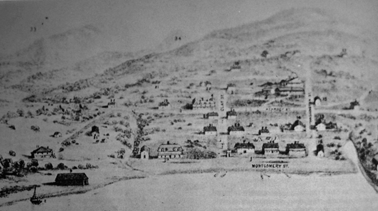
The sleepy village of yerba buena - about to decimate the oysters?

Hydraulic mining sediment also did not seem to be a likely explanation. The sediment peaked in 1890, the sediment was not evenly distributed, and in some places the sediment even decreased.

And in nowhere in the literature of eating after 1850 did anyone ever make much mention of the native oyster. Imports from Japan and the east coast got the lion share of the press.  Furthermore, any over-harvesting impacts should have radiated outward from populated areas of the time. But there is no evidence of that.

So in Cohen’s mind, suddenly a different question arose. Were in fact the native oysters ever abundant?

He now dug deeper, looking at contemporary records, harvest records, laws & lawsuits, shell middens, and natural shell deposits. The earliest statement for abundance it turns out came in 1962 with no sources. The original source for “significant harvest” of native oysters seems to have come in 1979. There didn’t seem to be much in the way of contemporary records at all.

And nowhere else did he find any evidence of abundance. Unlike other oyster areas like Washington, there were not laws on the books about native oyster beds and harvesting. There were no lawsuits over ownership.

Finally though, looking at shell middens and shell deposits, he did find evidence for abundance. But it was not what he expected. Oysters were there in abundance, but more than 2000 years ago. The shell middens of the current era are full of clams and mussels. The large abundant oyster deposits were deep with in the bay’s sediments. The data matched each other pretty well. It seems the 1759-1850 abundance of the native oysters was something that was made up.

Andrew Cohen still left us with a mystery (and there are those who dispute Cohen’s evidence) why did they become less abundant 2000 years ago. There is no evidence that they were over-harvested by the Native Americans. Something seems to have changed about the bay, perhaps related to climatic events of the times. But that is perhaps a later talk.

The question for us now, is what about efforts to reintroduce the oyster to San Francisco Bay? Something else is at work to keep the oyster less than abundant, and it is not likely humans, do these little mollusks need our help?

For more information about the San Francisco Bay Estuary, check out “An Introduction to the San Francisco Bay Estuary” (download the PDF).

Andrew Cohen is the Director of the Center for Research on Aquatic Bioinvasions (CRAB) in Richmond. His research includes the science and policy of invasions, and he helped write California’s ballast water laws. He’s received a Pew Fellowship in Marine Conservation, the San Francisco BayKeeper’s Environmental Achievement Award, and in 1994 was named by the Bay Chapter of the Sierra Club as the Best Public Official for the Environment.